
 Author: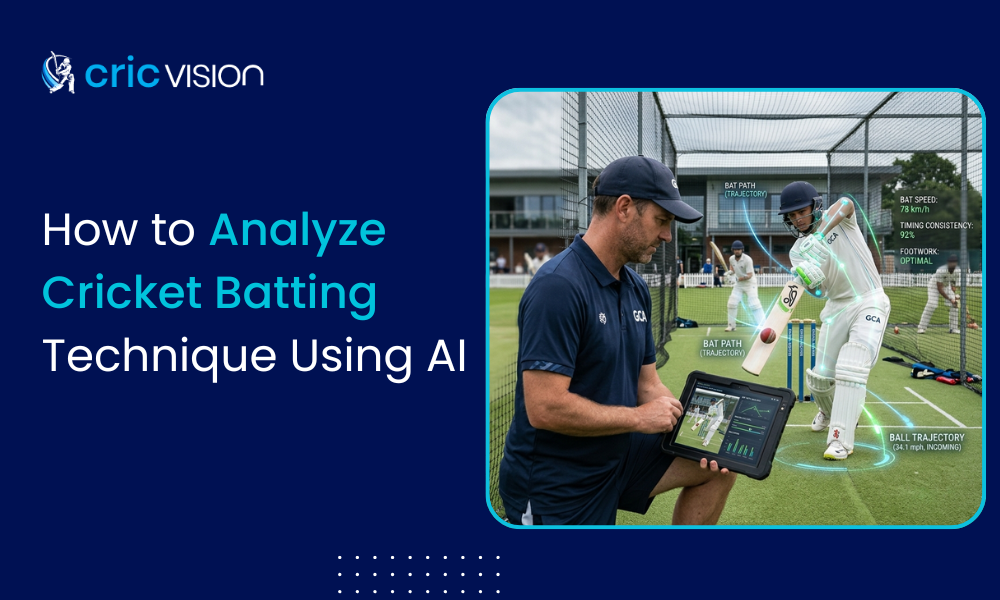
A coach’s eye can catch a lot in the nets. But it can’t catch everything not at match speed, not on every ball, and not for every player on a squad of thirty. That’s the gap AI batting analysis is built to close.
If you’ve ever wondered how to analyze cricket batting technique using AI, the short answer is: you record a batter facing a few balls, run the footage through an AI cricket coaching app, and get back a frame-by-frame breakdown of stance, backlift, bat path, footwork, and impact often within minutes. This guide walks through exactly how that process works, what it measures, the flaws it’s best at catching, how to set up a session properly, and how to put it into practice, whether you’re a solo coach, an academy, or a player working on your own game.
Why Traditional Batting Analysis Falls Short
Before AI entered the picture, batting technique analysis relied almost entirely on:
- A coach’s real-time observation during net sessions
- Manually scrubbing through slow-motion video, frame by frame
- Verbal or handwritten notes that were hard to track over time
- Subjective comparisons (“your head fell over” vs. an actual angle measurement)
This works, but it doesn’t scale. A coach reviewing footage manually might spend 20–30 minutes analyzing a single player’s session time that could go toward actual coaching. It also introduces inconsistency: two coaches watching the same shot can walk away with different conclusions, and a coach who’s just finished a three-hour session has less sharp judgment on ball forty than on ball four.
There’s also a memory problem. Even a good coach can’t hold six weeks of a player’s technique in their head with any precision. They remember impressions “he’s driving better” rather than data. That makes it hard to prove a change is really working or to catch a bad habit creeping back in before it shows up in a game.
How AI Batting Technique Analysis Actually Works
AI cricket coaching platforms combine computer vision, pose estimation, and ball-tracking algorithms to turn raw video into structured data. Here’s the general pipeline:
1. Video Capture
A phone, tablet, or fixed camera records the batter from one or more angles (front-on and side-on views give the most complete picture). Some setups add an overhead or behind-the-bowler angle for line-and-length context.
2. Skeleton and Pose Tracking
The AI maps the batter’s joints head, shoulders, hips, knees, wrists onto a digital skeleton for every frame. This is what allows the system to measure angles that are nearly impossible to judge by eye, like head position at the point of impact or hip rotation through the shot.
3. Ball and Bat Path Tracking
Separately, the software tracks the ball from release to impact and the bat from backlift to follow-through, plotting both as visual paths overlaid on the video. This is how bat speed, ball speed, and the exact impact frame get measured rather than estimated.
4. Segmentation
Long practice sessions are automatically split into individual deliveries, so a coach doesn’t have to scrub through 40 minutes of footage to find the three balls that mattered. This alone is often the single biggest time-saver in the whole workflow, and it’s one of the clearest examples of AI video analysis doing work a coach used to do by hand.
5. Metric Generation
The system converts all of this into readable numbers and visuals bat speed, ball speed, impact frame, pitch map, backlift angle rather than raw video a coach has to interpret manually.
6. Report and Comparison
Finally, the analysis is packaged into a shareable report, often with side-by-side comparisons against the player’s own past sessions or professional benchmarks. Some platforms let a coach annotate directly on the frame with voice or text notes, so feedback is tied to a specific moment rather than a general comment after the fact the same approach covered in how CricVision tracks player progress over a season rather than a single session.
What AI Can Actually Measure in a Batting Technique
AI video analysis can break a batting technique down into individual movements rather than simply showing a replay of the shot. It can examine how a player sets up, moves the bat, positions their body, and makes contact with the ball.
Stance: AI can analyze the width of the base, weight distribution, and overall alignment. These details matter because an unstable or poorly aligned stance can affect balance throughout the shot.
Backlift: The system can track the angle and direction of the bat during the backlift. This helps coaches understand whether the setup is contributing to a consistent bat path as the player moves toward the ball.
Bat Path: AI can analyze the trajectory of the bat throughout the swing, including from front and side views. This makes it easier to identify whether the bat is traveling straight through the ball or coming across the line.
Footwork: By tracking front- and back-foot movement in relation to ball release, AI can help identify whether a player’s movement is early, late, or misaligned with the line and length of the delivery.
Head Position: AI can assess head stability and alignment, particularly around impact and the front knee. Head movement can have a significant effect on balance, timing, and shot control.
Impact Point: AI can identify the frame in which the bat meets the ball and analyze where that contact occurs relative to the player’s body. This helps determine whether the ball is being played under the eyes or too far away from the body.
Ball Speed and Pitch Map: Across a session, AI can capture ball speed and map where deliveries land. Over time, this gives coaches useful data for identifying patterns and evaluating consistency.
Follow-Through: The system can also examine the direction and completion of the swing after contact. A controlled follow-through can provide additional insight into whether the player committed fully to the shot or had to check the swing.
The important point is that AI does not just make a batting video easier to watch. It turns individual movements within that video into measurable points that a coach can review, compare, and discuss with the player.
What once required specialist video analysis and sports science equipment can now be incorporated into a coach’s regular training workflow. The technology provides the measurements; the coach provides the context, correction, and coaching decision.
If you want to go deeper into one specific metric, how to improve bat speed looks at what actually influences bat speed beyond simply trying to swing harder.
Common Batting Flaws AI Is Especially Good at Catching
Some technical faults are genuinely hard to spot with the naked eye at full speed, which is exactly where AI-powered batting technique improvement earns its keep:
Head fall-away at impact
A batter’s head drifting away from the ball rather than staying still over the front knee is one of the most common causes of mistimed shots, and it often happens too fast to see live.
Inconsistent backlift direction
A backlift that drifts toward gully or fine leg, rather than straight back over the stumps, quietly shapes the whole bat path that follows.
Late or early foot movement relative to ball release
Footwork that looks fine in isolation can actually be a fraction of a second out of sync with the bowler’s release something a frame-accurate measurement catches far more reliably than an eye in real time.
Bat path drift across multiple deliveries
One bad shot doesn’t mean much, but a bat path that consistently comes down 5–10 degrees across the line, ball after ball, points to a real technical issue worth addressing.
Weight transfer that stalls
Weight that doesn’t fully transfer onto the front foot for drives, or back for the pull and cut, shows up clearly in pose-tracking data even when it’s subtle to the eye.
Recognizing these patterns is less about spotting a single “wrong” shot and more about seeing what repeats across ten or fifteen deliveries, which is exactly the kind of pattern AI is built to surface.
Step-by-Step: Analyzing a Batter’s Technique with an AI Cricket App
Set up two camera angles
Front-on (facing the batter) and side-on (square of the wicket) for the most complete read on stance and bat path.
Position cameras at a consistent height and distance
Every session. Even small changes in camera angle can distort measured angles slightly, so keeping setup consistent matters if you’re comparing sessions over time.
Record a full net session or drill
letting the AI segment it into individual balls automatically rather than manually clipping footage.
Review the skeleton and bat-path overlay
For each delivery to spot patterns not just one bad shot, but a repeated issue across 10–15 balls.
Cross-reference with the pitch map and ball speed data
To see whether technical issues cluster against a particular line or length a flaw that only shows up against a good-length ball, for instance.
Compare against a baseline
Either the player’s own technique from a previous session or a professional’s for reference.
Add coaching notes directly on the clip
voice or text so feedback is tied to the exact moment, not a vague memory of “the third ball.”
Generate a one-tap report
To share with the player or their parents, turning a subjective conversation into something visual and specific.
Track trends over weeks
Not just single sessions, to see whether a technical change is actually sticking under game pressure, and revisit the baseline periodically as the player improves.
Setting Up Your First AI Batting Analysis Session
Getting clean, useful data starts before you press record. A few practical habits make a noticeable difference:
Light matters more than camera quality
Even a high-end phone camera struggles with pose tracking in poor light or heavy backlighting from a low sun behind the batter. Where possible, shoot with the light source behind the camera, not behind the player.
Keep the batter fully in frame throughout the shot
Including the follow-through cropping the top of the backlift or the end of the swing loses data the AI needs.
Use a stable mount rather than handheld footage
Wherever practical. A slight camera wobble doesn’t stop analysis, but it does add noise to fine-grained angle measurements.
Film a realistic number of balls per session
Three deliveries won’t reveal a pattern; twelve to twenty gives the AI (and the coach) enough repetitions to distinguish a one-off mistake from a genuine technical habit.
Vary the bowling where possible
Pace, spin, and different lengths so the analysis reflects how the batter actually performs against a range of deliveries, not just one comfortable ball type in the nets.
None of this requires expensive equipment. It’s mostly about consistency and a bit of planning before the session starts, which pays off in cleaner comparisons later.
AI vs Manual Review: Which Should You Use?
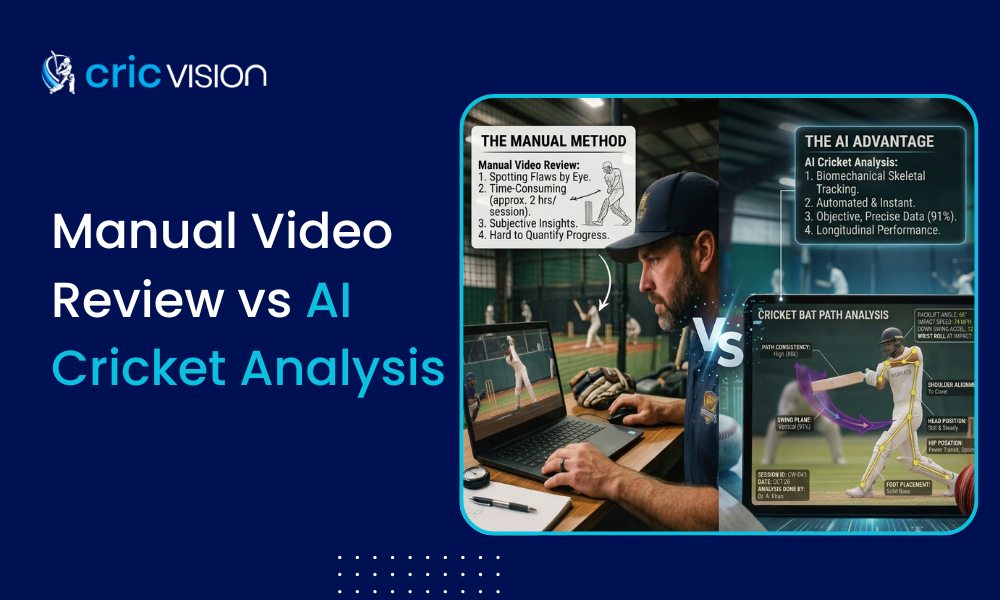
Most academies don’t need to choose one exclusively, but the trade-offs are clear, and they’re laid out well in cricket performance analysis research on where coaching still depends on judgment versus where data does the heavy lifting:
- Manual review is fine for a single, occasional look at technique, and a coach’s eye is still essential for reading intent, temperament, and game awareness things video alone won’t tell you. But it doesn’t scale across a squad or over a season.
- AI-powered analysis turns every net session into measurable data, cuts review time from tens of minutes to seconds per player, and keeps a consistent, comparable record over time.
In practice, the strongest setups combine both: AI handles the measurement and pattern detection, and the coach handles the interpretation and the conversation with the player. This mirrors the broader shift described in how AI is transforming cricket coaching AI doesn’t replace coaching judgment, it gives that judgment better raw material to work with.
What to Look for in an AI Cricket Coaching App
Not all AI batting analysis tools cover the same ground. When evaluating options, it’s worth checking for:
- Automatic ball-by-ball segmentation, so sessions don’t need manual clipping before analysis can begin.
- Multi-angle support, ideally front-on and side-on at minimum, since single-angle analysis misses either bat path or footwork depending on which view you choose.
- Skeleton/pose tracking, not just slow-motion playback, since pose data is what actually produces measurable angles rather than a visual impression.
- Shareable, exportable reports that a parent or player can review without needing the app open in front of them.
- Session-over-session comparison, so progress (or regression) is visible over weeks, not just within a single practice.
- Annotation tools for voice or text notes tied to a specific frame, which keeps feedback specific rather than general.
- White-labeling, if you’re running an academy, so the tool reinforces your academy’s brand rather than a third party’s part of a broader move to grow a cricket academy with technology rather than bolt-on tools.
How CricVision Fits In
CricVision is built specifically for this workflow. Its AI batting analysis tools cover skeleton video tracking, stance and backlift analysis, bat path and ball path visualization, and automatic ball-by-ball segmentation, all packaged into one-tap PDF reports coaches can hand straight to players and parents. For academies, it comes as a white-labeled app, so all of this AI batting-technique analysis sits under the academy’s own brand rather than a third-party tool, alongside dashboards for tracking player progress throughout the season.
Coaches already using CricVision have found it changes not just how fast feedback happens, but how consistent it is across an entire academy every player gets the same level of technical detail, not just the ones a coach happens to have more time for that week.
Limitations Worth Knowing About
AI batting analysis is powerful, but it isn’t magic, and it’s worth going in with realistic expectations:
It measures technique, not intent or shot selection.
A technically clean cover drive played to the wrong ball is still the wrong decision. AI won’t tell you that on its own; a coach still needs to make that judgment call.
Data quality depends on setup.
Poor lighting, an obstructed camera, or an inconsistent angle between sessions can all introduce noise into the measurements.
It works best with volume.
A single delivery tells you very little; the real value comes from spotting patterns across many balls and many sessions.
It’s a tool for coaches, not a replacement for them.
The most effective use of AI batting analysis pairs the data with a coach’s understanding of the player – their confidence, their game situation, their long-term development, none of which shows up in a skeleton overlay.
Used with those limitations in mind, AI analysis becomes a multiplier on good coaching rather than a substitute for it.
FAQ
Can AI really analyze batting technique accurately?
Yes. AI pose-tracking and ball-tracking systems used in cricket coaching apps can measure joint angles, bat path, and timing with a level of precision and consistency that’s difficult to replicate by eye, especially across many repetitions.
Do I need special cameras for AI batting analysis?
No. Most modern AI cricket coaching apps, including CricVision, work with standard smartphone video though using two angles (front-on and side-on) gives a more complete analysis than one, and good, even lighting improves tracking accuracy.
What’s the difference between AI batting analysis and a normal slow-motion replay?
A slow-motion replay just plays footage back slower; it still requires a coach to interpret everything manually. AI analysis adds skeleton tracking, ball path, bat speed, and automated metrics on top of the video, turning it into structured, comparable data rather than a visual impression.
Is AI batting analysis only for professional players?
No it’s increasingly used at academy and youth level precisely because it gives every player, not just the most promising ones, consistent, detailed feedback that a coach couldn’t otherwise provide to a full squad.
How often should a batter’s technique be analyzed with AI?
Most coaches review footage every session or every few sessions, since trends across multiple net sessions reveal more than a single one-off snapshot of technique. Periodic comparison against an earlier baseline also helps confirm whether a change is genuinely sticking.
Does AI batting analysis replace a coach?
No. It replaces the manual, time-consuming parts of video review scrubbing footage, measuring angles by eye, taking notes but the interpretation, the conversation with the player, and decisions about what to actually work on still rest with the coach.
Conclusion
Analyzing cricket batting technique with AI isn’t about replacing a coach’s eye it’s about giving that eye better information. Stance, backlift, bat path, footwork, and impact position can all be measured, tracked, and compared over time instead of judged from memory, and patterns that repeat across a session are far easier to spot in data than in real time. For coaches and academies looking to make that shift, CricVision packages the entire process capture, analysis, reporting, and coach-player communication into one app built specifically for cricket.
Book an Academy Demo to see AI batting analysis in action.