
 Author: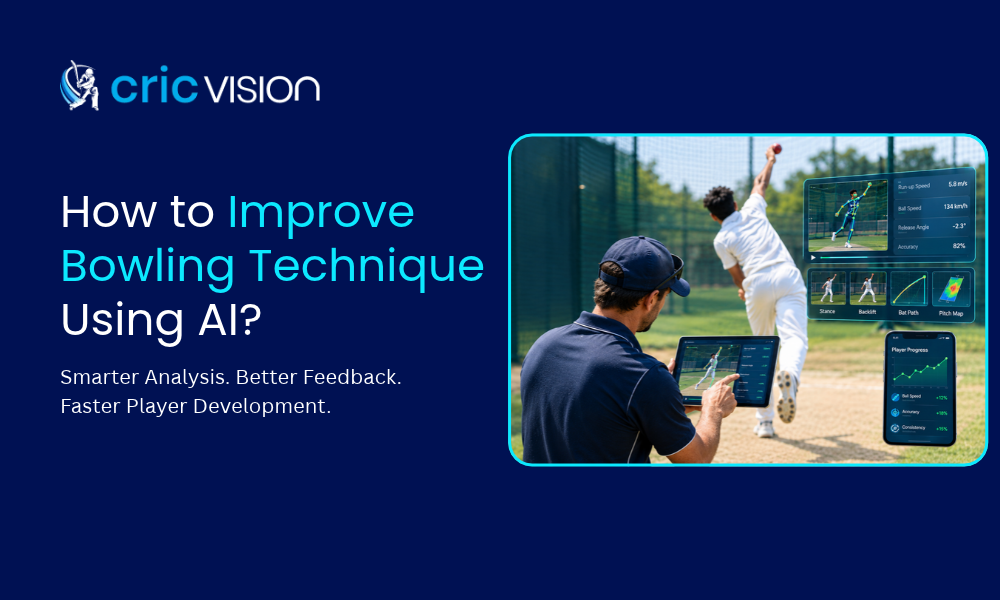
A junior fast bowler finishes a spell, and the coach already knows what needs to be fixed: the run-up is inconsistent, the front leg is collapsing, and the bowler is losing control at release. The problem is not identifying the issue. The problem is finding enough time to review every delivery, compare it with previous sessions, explain the correction clearly, and then check whether the player actually improved.
That challenge becomes much harder when a coach is responsible for 15, 20, or even more bowlers.
Traditional coaching still depends heavily on observation and experience, and those remain essential. But video analysis and performance data can give coaches another layer of information. Instead of relying only on what can be seen during a live session, coaches can review movement frame by frame, compare sessions, identify patterns, and give players more consistent feedback.
This is where AI-assisted video analysis can become useful.
Why Bowling Technique Is Difficult to Analyze
Fast bowling is a highly coordinated movement involving the run-up, delivery stride, lower body, pelvis, trunk, shoulders, arm action, and release.
A small change in one part of the movement can affect what happens later in the delivery.
Research has identified relationships between bowling technique, ball release speed, and injury-related characteristics. For example, a study of 42 high-performance male fast bowlers found associations between faster ball release and factors including front-knee behavior, impact forces, hip-shoulder separation, and shoulder rotation.
More recent research is showing that coaches may also need to look earlier in the delivery sequence. A 2026 study of 29 elite male fast bowlers identified 15 significant correlations between pre-delivery stride characteristics and technique variables associated with performance and lumbar bone-stress injury. The researchers found that factors such as run-up velocity, take-off angle, pelvic position, and landing characteristics were connected with what happened later in the bowling action.
That makes bowling analysis more complicated than simply asking whether the ball went fast or whether the bowler hit the target.
The coach needs to understand how the bowler arrived at the release point.
What Can AI Video Analysis Look for in Bowling?
AI does not replace a coach’s understanding of technique. Its value is in helping turn video into structured information that is easier to review and compare.
With the right video-analysis system, coaches can examine several parts of a bowling action.
1. Run-Up and Pre-Delivery Movement
The run-up establishes rhythm and momentum before the bowler reaches the crease.
Video analysis can help coaches compare:
- Run-up consistency
- Approach rhythm
- Body position during the final steps
- Take-off characteristics
- Delivery-stride consistency
- Changes between sessions
This is particularly useful when a player says, “It felt different today,” but the coach needs to determine exactly what changed.
The 2026 fast-bowling study mentioned earlier is particularly relevant here because it found relationships between pre-delivery stride characteristics and later technique variables.
Instead of reviewing the entire session manually, coaches can focus their attention on the deliveries or movement phases where a meaningful change appears.
2. Front-Leg and Lower-Body Mechanics
The front leg plays an important role in transferring momentum during delivery.
A coach may notice that a bowler’s front leg is collapsing or that the landing position has changed, but identifying the pattern across multiple deliveries can be difficult during a live session.
Slow-motion video and movement tracking make it easier to compare:
Good delivery → technical change → resulting delivery
The objective is not to create a perfect-looking bowling action. It is to help the coach determine whether a particular movement pattern is consistent, changing, or associated with a specific performance problem.
Research also supports the importance of examining lower-body and lumbopelvic movement. In a study of 50 elite male fast bowlers, 39 subsequently sustained a lumbar bone-stress injury, and several technique variables differed between bowlers who did and did not experience injury. The study identified rear-hip and lumbopelvic characteristics as particularly relevant variables.
That finding does not mean AI video analysis can diagnose or predict an injury by itself. It does show why detailed movement analysis can be valuable when coaches and qualified sports science professionals are evaluating bowling technique.
3. Shoulder and Trunk Movement
The upper body is another important part of the bowling action.
Excessive shoulder counter-rotation has been studied extensively in relation to fast-bowling biomechanics. A review covering 56 studies reported a substantially higher reported risk of lumbar injury among bowlers displaying excessive shoulder counter-rotation, although the authors also noted that shoulder counter-rotation is only a surrogate measure and may not fully represent actual spinal movement.
For a coach, the practical takeaway is simple:
Don’t judge one frame in isolation. Look for movement patterns across deliveries and sessions.
AI-assisted video can make that comparison easier by allowing coaches to review the same phase repeatedly, use multiple camera angles, slow the footage down, and compare clips.
4. Release Position and Consistency
The release point is where several technical components come together.
A bowler may have a technically sound run-up but still struggle with:
- Release consistency
- Alignment
- Direction
- Timing
- Body position at release
- Repeatability under fatigue
AI-assisted video can help coaches identify whether these issues occur occasionally or repeatedly.
This distinction matters.
If one delivery looks unusual, it may simply be an execution error. If the same movement appears across 20 deliveries, it becomes a coaching pattern worth investigating.
That is one of the biggest advantages of combining video with performance data: coaches can move from isolated observations toward evidence across multiple repetitions.
AI Can Help Coaches Review More Than One Player
This becomes particularly valuable inside a cricket academy.
A coach working with one elite bowler can spend considerable time reviewing video manually. A junior coach managing 15 players has a different problem.
Every player needs individual attention, but the coach’s time is limited.
Manual video review can involve:
- Recording the session
- Finding relevant deliveries
- Scrubbing through footage
- Replaying movements
- Creating clips
- Comparing previous sessions
- Writing feedback
- Explaining the correction
- Checking progress later
When this process is repeated for an entire squad, video analysis can become a significant workload in itself.
AI-assisted systems can help reduce that friction by organizing footage, identifying useful moments, supporting slow-motion review, and helping coaches create structured reports.
The goal is not to remove the coach from the process.
It is to reduce the amount of time the coach spends searching through video and organizing information, so more time can be spent actually coaching.
Use Performance Data Alongside Video
The video tells you what happened.
Performance data can help show whether it is happening consistently.
For example, a coach might track:
- Ball speed
- Accuracy
- Line and length
- Release consistency
- Delivery outcomes
- Session-to-session changes
- Player-specific technical markers
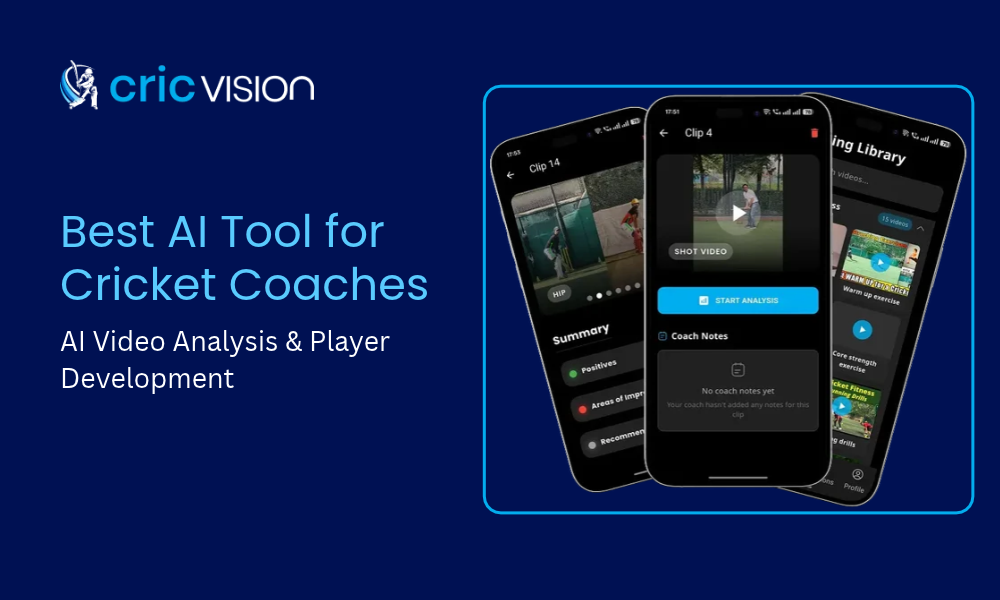
CricVision is designed around this combination of video analysis, performance information, player progress tracking, and coach feedback. Its platform supports session recording, video clips, performance reports, AI-assisted visual analysis, written or voice feedback, personalized drills, and sharing reports with players and parents.
The important part is not having more numbers for the sake of having more numbers.
The important part is connecting the data to a coaching decision.
For example:
Observation: The bowler is losing control late in the session.
Video: The delivery action becomes less consistent as fatigue increases.
Performance data: Accuracy drops across the final group of deliveries.
Coaching action: Reduce technical complexity, adjust the drill, and monitor the next session.
That creates a much clearer coaching loop.
AI Can Make Feedback More Consistent
One of the challenges in academy environments is feedback consistency.
A coach may work with several players in one day. Different sessions, different workloads, and simple human limitations can make it difficult to remember every technical detail.
AI-assisted video analysis can help create a visual record of what was discussed.
Instead of telling a player:
“Your front side was opening too early.”
The coach can show the relevant clip, slow it down, compare it with another delivery, and add a specific explanation.
The player then has something concrete to review between sessions.
This is particularly useful for younger players who may struggle to understand a technical instruction without seeing it.
Track Progress Over Time, Not Just Session by Session
Improving bowling technique is rarely about fixing everything in one session.
A player might improve their alignment but temporarily lose rhythm. Another might increase consistency while working on a technical adjustment.
That is why progress tracking matters.
A useful digital coaching workflow should allow coaches to compare:
Previous action → current action → coaching intervention → next review
Player progress dashboards can help organize statistics, milestones, and development information so coaches have a clearer history of the player’s development. CricVision’s platform includes player progress dashboards and tools for sharing performance reports and feedback with players and parents.
For academy owners and head coaches, this creates another advantage: the player’s development becomes easier to document rather than being stored primarily in a coach’s memory.
Bowling Workload Also Matters
Technique cannot be separated completely from workload.
A technically sound action can still be exposed to problems if a player experiences excessive workload or insufficient recovery.
A 2026 systematic review and meta-analysis synthesized 33 studies on cricket fast-bowling workload and found that high acute workloads, rapid workload increases, and inadequate recovery were consistently associated with increased injury risk. Across six prospective studies included in the meta-analysis, elevated acute-to-chronic workload exposure was associated with a relative risk of 2.45, although substantial heterogeneity existed between studies. The authors recommended progressive load development, adequate recovery, and individualized interpretation rather than relying on rigid thresholds.
This is another area where digital records can help.
If a coach can see a player’s technical changes alongside session history and workload information, the conversation becomes more informed.
Again, this is not a substitute for medical or sports-science assessment. It is a way to give coaches better information when making training decisions.
AI Should Support the Coach, Not Replace the Coach
There is an important distinction between AI-assisted coaching and AI-led coaching.
AI can identify patterns in video and data, but it does not know the complete context of a player.
A coach knows whether a player is returning from a break, changing their action intentionally, struggling with confidence, adapting to a new pitch, or learning a completely new technical movement.
Research also shows why caution is necessary. A systematic review of 25 studies examining intrinsic factors associated with low-back pain and lumbar injury in fast bowlers found considerable inconsistency in the evidence, with most included studies judged to have a high risk of bias.
So AI-generated observations should be treated as decision-support information, not as an automatic diagnosis or definitive coaching instruction.
The coach remains responsible for interpreting the information and deciding what intervention makes sense for that individual player.
How AI Can Solve Common Academy Coaching Problems
For many academies, the biggest opportunity is not simply adding AI to the training environment. It is improving the coaching workflow around existing problems.
Manual video review
Instead of spending large amounts of time searching through footage, coaches can use AI-assisted tools to identify and organize relevant clips, slow down movement, compare deliveries, and build reports.
Inconsistent feedback
Video provides a shared reference point between coach and player. The coach can document the technical issue, show the evidence, and revisit it during the next session.
Limited visibility into progress
Digital performance records make it easier to compare current and previous sessions rather than relying entirely on memory.
Fragmented coach-player-parent communication
Instead of relying on separate messages or verbal updates, coaches can share reports, clips, and feedback through a centralized coaching environment. This gives parents greater visibility into what the player is working on without requiring them to interpret every training session themselves.
These are practical problems that matter when a coach is managing a large group of players.
A Practical AI-Assisted Bowling Coaching Workflow
An academy does not need to completely redesign its coaching process to start using video intelligence.
A practical workflow can look like this:
Record → Analyze → Review → Coach → Practice → Measure → Compare
First, record the bowler from appropriate angles.
Then use video analysis to identify relevant movement patterns and technical moments.
The coach reviews those findings rather than accepting them automatically.
Next, the coach selects one or two priorities for the player instead of overwhelming them with corrections.
The player practices through targeted drills.
Performance and video are then captured again.
Finally, the coach compares the new footage with previous sessions and decides whether the intervention worked.
This creates a continuous feedback loop rather than a one-time technical assessment.
What Academy Owners Should Look for in an AI Coaching Platform
If you are evaluating AI video-analysis software for your academy, focus less on how many AI features a platform lists and more on whether it improves the coaching workflow.
Look for a system that makes it easy to:
- Record and organize training footage
- Create and review clips
- Analyze movement visually
- Compare player performance over time
- Add coach-written or voice feedback
- Create player reports
- Assign personalized drills
- Track development
- Share useful information with players and parents
The platform should make coaching more efficient, not create another dashboard that coaches have to maintain.
Conclusion: Better Bowling Analysis Starts With Better Information
Improving bowling technique still depends on coaching knowledge, repetition, practice design, and player commitment.
AI does not change that.
What it can change is how quickly coaches can turn training footage into useful information.
Research continues to show that fast bowling involves complex relationships between movement, performance, workload, and injury-related characteristics. Recent studies are also expanding the analysis beyond the release itself to include the pre-delivery stride and broader movement patterns.
For cricket academies managing multiple players, that creates a practical opportunity use AI video analysis to reduce manual review, make feedback more consistent, document development, and keep coaches, players, and parents better connected.
The objective is not to let AI coach the bowler.
It is to give the coach better evidence, better context, and more time to do what coaches do best help players improve.
So, if your coaches could spend less time searching through video and more time turning that video into meaningful coaching decisions, what could that change for your players?