

 Author: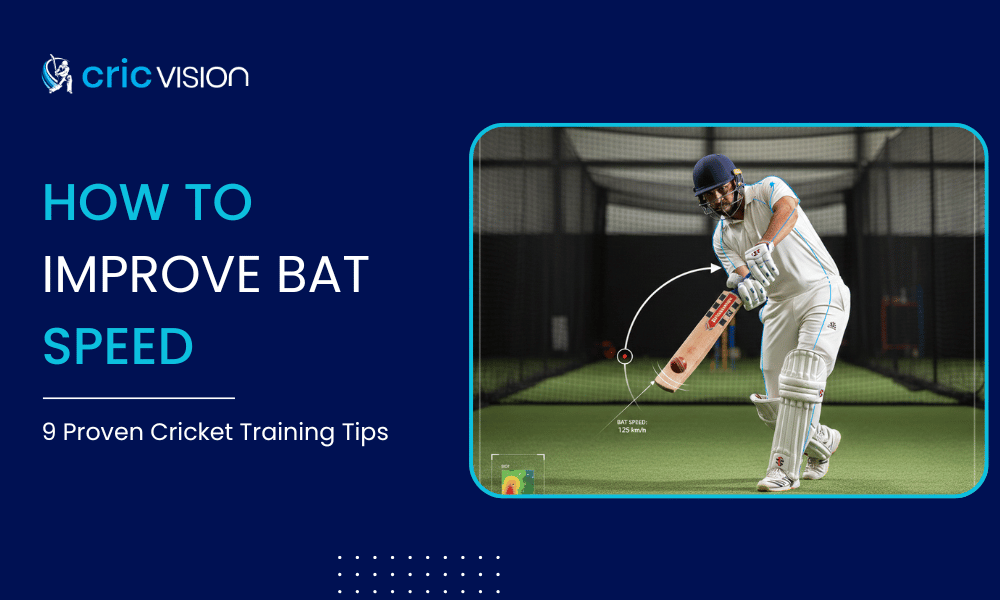
Bat speed plays an important role in modern cricket batting. A faster, controlled swing can help a batter meet the ball effectively, generate power, and play shots with greater confidence.
However, how to improve bat speed is not simply a matter of swinging the bat harder. Batting technique, backlift, bat path, wrist control, strength, footwork, timing, and coordination all contribute to an effective swing.
The goal is to develop faster and more efficient bat movement without sacrificing balance, control, or timing.
What Is Bat Speed in Cricket?
Bat speed refers to how quickly the cricket bat moves through the swing and toward the point of contact with the ball.
Higher bat speed can contribute to stronger shots, but speed alone does not guarantee better batting. A batter also needs to make clean contact and control the bat face at impact.
For that reason, improving bat speed should be part of a broader cricket batting technique program rather than an isolated training goal.
Why Is Bat Speed Important for Batters?
Bat speed can influence how effectively a batter transfers energy into the ball. When combined with good timing and clean contact, efficient bat speed can help produce more powerful shots.
It can also give batters more options when facing different types of bowling. A well-prepared swing allows the player to react to pace and adjust the shot while maintaining control.
The important point is that bat speed, timing, and bat control need to work together.
What Affects Bat Speed in Cricket?
Several parts of a batter’s technique and physical preparation can influence swing speed.
Batting Technique
Efficient movement allows the batter to transfer energy through the swing without unnecessary motion.
A technically sound swing can make it easier to generate speed while maintaining balance and control.
Backlift and Bat Path
The backlift prepares the bat for the downswing, while the bat path determines how efficiently the bat travels toward the ball.
Unnecessary movement can make the swing less efficient and affect timing.
Strength and Coordination
Wrist, forearm, core, and lower-body strength can support a powerful swing. Hand-eye coordination is equally important because the batter must control that movement at the right moment.
How to Improve Bat Speed in Cricket
If you want to know how to improve bat speed, focus on technique first and then build the physical qualities that support a faster swing.
1. Improve Your Batting Stance
A balanced batting stance gives you a stable starting position for the shot.
Your stance should allow you to move quickly while keeping your head and body controlled. Excessive tension can make movement slower and less fluid.
Focus on:
- A comfortable and balanced stance
- Relaxed hands and shoulders
- A stable head position
A good stance does not need to look identical for every player. The objective is to create a position from which you can move efficiently.
2. Develop an Efficient Backlift
The backlift prepares the bat before the downswing begins.
Instead of simply trying to lift the bat higher, focus on creating a repeatable movement that allows you to get into the hitting position comfortably.
A controlled backlift can help you prepare earlier and maintain a consistent swing.
3. Work on Your Bat Path
The path of the bat is one of the most important areas to examine when working on how to improve bat speed.
An inefficient bat path can introduce unnecessary movement into the swing. A cleaner path can help you transfer energy more efficiently toward the ball.
Practice your swing slowly first. Once the movement becomes consistent, gradually increase the speed while maintaining control.
4. Strengthen Your Wrists and Forearms
Your wrists and forearms play an important role in controlling the bat.
Developing appropriate strength can help you maintain stability through the swing and control the bat face during contact.
Include cricket-specific strength work alongside your regular training, rather than relying only on repeated full-speed swings.
5. Build Core and Lower-Body Strength
Bat speed does not come only from your arms.
Your lower body and core help create a stable base and contribute to rotational movement during the shot. Better coordination between the legs, hips, torso, arms, and wrists can make the overall movement more efficient.
Focus on:
- Core stability
- Rotational strength
- Lower-body strength
6. Improve Your Footwork
Good footwork helps you reach the ball in a position where you can use your swing effectively.
If your feet are late or your balance is poor, simply increasing swing speed may not improve the quality of your shots.
Practice moving into position early while keeping your head stable and your body balanced.
7. Practice Bat Speed Drills
Specific drills can help you develop faster and more controlled bat movement.
Start with shadow batting and controlled swings before progressing to more reactive drills. The objective should be to increase speed without allowing your technique to break down.
Useful practice methods include:
- Shadow batting
- Controlled high-speed swings
- Throwdown and reaction drills
Record your sessions when possible so you can compare technique and consistency over time.
8. Improve Timing and Hand-Eye Coordination
Fast bat movement is only useful when it arrives at the ball at the right time.
A batter with excellent timing can often produce effective shots without simply trying to swing as hard as possible.
Practice tracking the ball, judging its length, and meeting it with a controlled bat face. This helps connect bat speed, timing, and shot quality.
9. Use Video Analysis to Measure Your Batting Technique
One of the biggest challenges in improving bat speed is knowing exactly what needs to change.
A player may feel that the swing is slow when the actual problem is poor bat path, late movement, inefficient backlift, or inconsistent contact.
Video analysis allows players and coaches to review the movement instead of relying only on memory or observation.’
How CricVision Can Help Improve Batting Technique
Once you understand how to improve bat speed, the next challenge is measuring whether your technique is actually improving.
This is where AI-powered cricket video analysis can add value.
CricVision provides AI-powered cricket analysis features that can help players and coaches examine batting movement through video. Its platform includes bat-path, stance, backlift, footwork, head-position and skeleton-video analysis, along with bat-speed measurement and impact-frame identification.
Instead of asking only, “Did I swing faster?”, a player can look deeper at how the swing was produced.
For example, a coach can review:
- Bat path and swing movement
- Backlift and body positioning
- Bat speed and impact frame
This creates a more useful training cycle:
Record → Analyze → Correct → Practice → Record Again
CricVision’s existing batting-analysis approach is designed around reviewing individual shots and identifying technical details that can be difficult to see at full speed.
Why Video Feedback Matters
A coach may see that a player is losing power, but the cause may not be immediately obvious.
Video analysis makes it possible to slow down the movement, review different angles, and compare repeated attempts. This can help players understand whether they need to work on their stance, backlift, bat path, timing, or contact.
The technology should complement coaching rather than replace it. The coach still provides context and decides which technical changes are appropriate for the player.
Bat Speed vs Batting Power: What’s the Difference?
Bat speed and batting power are related, but they are not exactly the same.
A player can swing quickly but still produce inconsistent shots if the contact point or bat face is poor.
This is why the objective should not simply be maximum bat speed.
The better goal is efficient bat speed with consistent timing and control.
Common Mistakes That Can Reduce Bat Speed
Trying to improve bat speed can sometimes create new technical problems.
Swinging Too Hard
Trying to hit every ball as hard as possible can create unnecessary tension.
A relaxed and efficient swing can be more effective than forcing maximum effort.
Using Only the Arms
A coordinated batting movement involves more than the arms.
The legs, hips, torso, shoulders, arms, and wrists need to work together to produce an efficient movement.
Ignoring Technique
Increasing swing speed without fixing an inefficient bat path or poor balance may not improve overall batting performance.
Technique should remain the foundation of speed development.
A Simple Bat Speed Training Approach
A structured session can combine technique, physical preparation, and feedback.
The most important part is consistency.
Instead of changing several aspects of your technique at once, identify one or two areas to improve, practice them, and then review your progress.
How Long Does It Take to Improve Bat Speed?
There is no single timeframe that applies to every player.
Progress depends on your current technique, training age, physical preparation, practice quality, and how consistently you train.
Rather than focusing only on how quickly you can increase bat speed, track improvements in:
- Swing consistency
- Contact quality
- Bat control
Regular video review can also help you determine whether a technical change is actually producing a better movement pattern.
Bat Speed Improvement Checklist
Before each training cycle, ask yourself:
- Is my stance balanced and relaxed?
- Is my backlift consistent?
- Is my bat path efficient?
Then review your physical preparation:
- Are my wrists and forearms strong enough?
- Is my core stable during rotation?
- Can I maintain balance while swinging quickly?
Finally, review your results:
- Is my bat speed improving?
- Is my contact becoming more consistent?
- Am I maintaining control while increasing speed?
FAQs About Improving Bat Speed
How can I improve bat speed in cricket?
Focus on efficient batting technique, strength, coordination, timing, and repeated practice. Video analysis can also help identify movement patterns that are difficult to notice during live practice.
What exercises increase bat speed?
Training should combine appropriate strength and power exercises with cricket-specific swing drills. Wrist, forearm, core, and rotational strength can support efficient batting movement.
How can I swing a cricket bat faster?
Start by improving your batting mechanics rather than simply trying to swing harder. A balanced stance, efficient backlift, controlled bat path, and coordinated body movement can help create a faster swing.
Does bat speed increase batting power?
Bat speed can contribute to shot power, but it works together with contact quality, timing, bat angle, and technique. A faster swing does not automatically produce better results.
Can video analysis help improve bat speed?
Yes. Video analysis can help players and coaches examine bat path, backlift, body movement, contact, and other technical factors. CricVision provides AI-powered cricket video analysis features designed to support this type of review.
Final Thoughts: Improve Bat Speed With Better Technique
Learning how to improve bat speed is not about forcing the bat to move faster.
It is about creating an efficient movement pattern and then developing the strength, coordination, timing, and control needed to repeat that movement consistently.
Start with your stance, backlift, bat path, footwork, and timing. Add appropriate strength and bat-speed training, then use video feedback to understand whether your technique is actually improving.
With tools such as CricVision, players and coaches can turn batting sessions into measurable video-based feedback and examine details such as bat path, backlift, footwork, bat speed, and impact.
Want to analyze your batting technique with AI? Explore CricVision and turn your cricket practice videos into actionable performance insights.