
 Author:
A head coach finishes a two-hour training session with 20 players. Each player has worked on different batting techniques, several clips need reviewing, and parents are waiting for updates on their children’s progress. The coach knows the footage contains useful information, but finding the time to analyze every clip and provide individual feedback is another challenge.
This is a familiar problem for cricket academy owners, head coaches, high-performance coaches, and junior coaches. As player groups grow, maintaining the same level of individual attention becomes increasingly difficult.
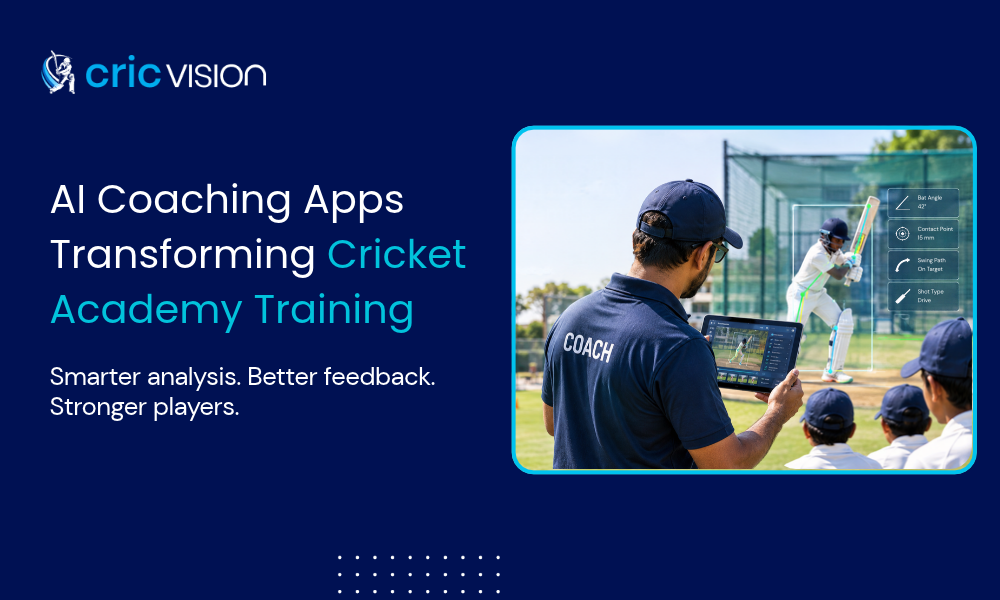
AI coaching apps are helping coaches approach this challenge differently. By combining video analysis, performance metrics, digital feedback, and progress tracking, these tools can make training reviews more structured and help coaches spend less time on repetitive tasks.
The goal is not to replace coaching expertise. It is to give coaches better information, make feedback easier to deliver, and help players understand what they need to improve.
Why Cricket Academies Need a More Consistent Coaching Process
Traditional cricket coaching depends heavily on observation, experience, and verbal feedback. These remain essential, but they can become difficult to scale when one coach works with multiple players across different age groups and skill levels.
A coach may notice that a batter is losing balance during a shot or making inconsistent contact with the ball. However, remembering every technical detail, reviewing all the footage, and checking whether the same issue appears in subsequent sessions takes time.
Three challenges are particularly common.
Manual video review takes time away from coaching
Coaches often record sessions on smartphones and review the footage later. Finding specific deliveries, identifying technical issues, and preparing clips for individual players can turn a short training review into a lengthy task.
Feedback can vary between players and sessions
Some players receive detailed video explanations, while others receive only a brief verbal correction. This does not necessarily reflect differences in coaching quality; it can simply be a consequence of limited time.
Player development is not always easy to demonstrate
A player might improve their balance, timing, or bat path over several weeks without noticing the change. When coaches cannot easily compare earlier and recent performances, progress discussions become less specific.
These challenges matter because effective coaching involves more than identifying mistakes. Players need clear explanations, relevant practice activities, and opportunities to see whether their adjustments are working.
How AI Video Analysis Helps Coaches Review Batting Technique
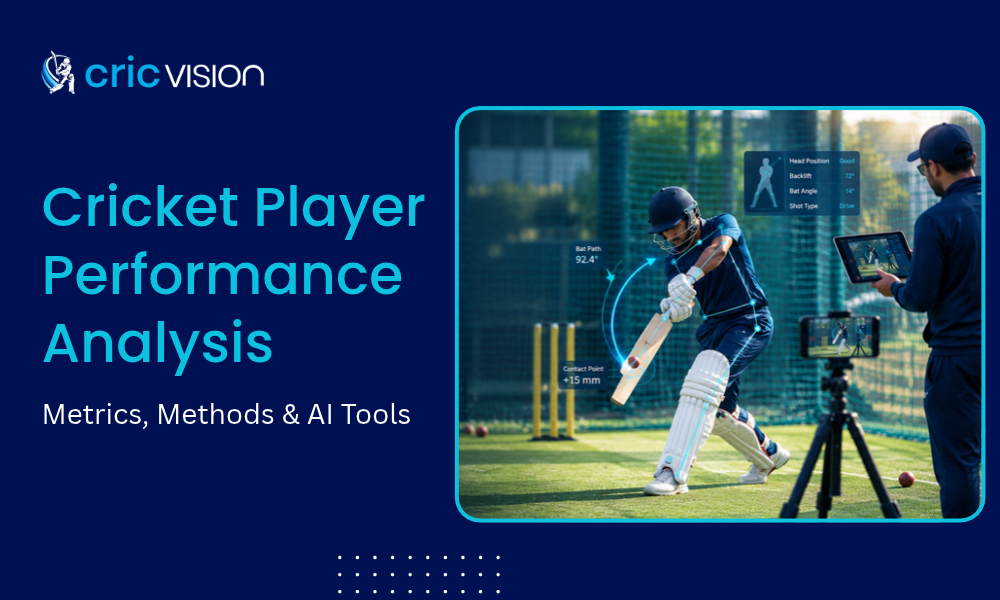
AI video analysis can turn ordinary training footage into a more structured review of batting performance. Depending on the platform and recording conditions, coaches can examine specific movements, isolate deliveries, and review technical details that may be difficult to assess consistently in real time.
Instead of watching an entire session repeatedly, a coach can focus on the moments that matter.
Identify technical patterns through video
Consider a junior batter who repeatedly loses balance when playing shots through the off side. During a live session, the coach may recognize the issue and offer a correction. But the player might not fully understand what is happening or why the movement matters.
Video analysis allows the coach to revisit the movement, slow down the footage, and examine the player’s stance, backlift, bat path, and body position around impact.
Skeleton views and front- or side-view comparisons can help coaches explain movement patterns visually. Bat-path analysis can provide another reference for discussing how the bat travels toward the ball.
The coach can then connect the observation to a practical instruction, such as maintaining a more stable base or adjusting the movement into the shot.
AI should support this process rather than dictate the correction. Camera angles, lighting, occlusion, and the quality of the recording can affect what a system identifies, so coaches should verify important findings against the original footage.
Review deliveries without searching through entire sessions
Ball-by-ball segmentation and automated clip creation can make it easier to locate individual shots or specific moments in a training session.
For a coach managing several players, this can reduce the repetitive work involved in finding relevant footage. Instead of starting from the beginning of a long recording every time, the coach can review selected clips and focus on the technical issue being addressed.
The practical benefit is not simply faster video processing. It is a more manageable review process that leaves more time for demonstrations, guided practice, and individual conversations.
Add performance context to technical feedback
Video becomes more useful when coaches can connect visible movement to relevant performance information.
Depending on the system, available metrics may include ball speed, bat speed, shot data, impact-frame identification, and pitch-map information. These measurements can help coaches explore questions about contact, timing, shot selection, and consistency.
For example, if a batter is making frequent contact but struggling to generate the intended shot, the coach can combine video observations with the available performance data to investigate possible explanations.
No single metric explains an entire batting performance. A higher bat speed does not automatically mean better technique, and a pitch map does not independently explain why a shot succeeded or failed. The value comes from interpreting measurements alongside the player’s objectives, skill level, and training context.
How AI-Assisted Feedback Can Improve Coaching Consistency
When an academy works with dozens of players, consistency is not about giving every batter the same advice. It is about ensuring that each player receives feedback that is clear, relevant, and connected to an identifiable training objective.
Digital coaching tools can help coaches record observations directly against video clips, add written or voice feedback, and share reports with players. Coaches can also assign individualized drills so that the next practice session builds on the previous review.
Imagine that two players are struggling with different aspects of their batting.
One player needs to improve balance during the initial movement. The other needs to understand the bat path leading into impact. A shared, generic instruction would not address both problems equally well.
With video-based feedback, the coach can show each player the relevant movement, explain the intended adjustment, and assign a drill that targets the specific issue. At the next session, the coach can review fresh footage and determine whether the player is applying the correction.
This creates a more connected coaching cycle:
Observe → Analyze → Explain → Practice → Review.
The cycle also helps coaches maintain a clearer record of what they have taught and what each player is working on. It does not eliminate differences in coaching judgment; it makes those judgments easier to communicate and revisit.
Research supports a careful, evidence-led approach. A 2022 systematic review published in PLOS ONE examined technology-assisted and other augmented feedback in cricket skill learning. The researchers identified 11 eligible studies, with five contributing to the meta-analyses. Although the results suggested potentially positive performance effects, the estimates were not statistically significant and had wide confidence intervals. The authors concluded that more research was needed.
The takeaway is important: video and data can improve the feedback process, but academies should evaluate whether their chosen methods actually help players learn rather than assuming that technology automatically improves performance.
Tracking Player Progress Beyond a Single Training Session
One of the most useful applications of digital coaching is the ability to compare performance over time.
A single video may reveal a technical issue, but it cannot reliably establish whether a player is improving. Development becomes easier to understand when coaches can compare relevant observations from earlier sessions with more recent performances.
Establish a baseline for each player
At the start of a development cycle, coaches can record a representative set of batting clips and document the main areas for improvement.
For one player, the priority might be maintaining balance. For another, it could be improving the consistency of the bat path or understanding contact timing.
The coach can then select a small number of relevant indicators and revisit them at agreed intervals. Comparing similar drills, recording angles, and training conditions makes these reviews more useful.
Look for trends instead of isolated results
Performance data can help coaches distinguish a one-off outcome from a recurring pattern. A player might execute a movement well in one delivery but struggle to reproduce it across a session.
Reviewing several relevant clips helps coaches assess consistency and decide whether a drill needs to be adjusted.
Progress dashboards and session reports can also make it easier to maintain a record of technical observations, assigned drills, and development milestones. Coaches should interpret these records in context, particularly when working with younger players whose coordination, strength, and confidence can change as they grow.
Make improvement visible to players
Young players often respond better when they understand what they are working toward and can recognize evidence of progress.
A coach can compare an earlier clip with a recent one, highlight a specific improvement, and explain the next development goal. The discussion then moves beyond a general statement such as “your batting looks better” to a more concrete explanation of what has changed.
This does not mean reducing a player’s development to scores or dashboards. Match awareness, decision-making, confidence, adaptability, and enjoyment remain important parts of performance that cannot be fully represented by a technical metric.
Improving Communication Between Coaches, Players, and Parents
Player development is easier to support when the people involved understand the training plan.
In junior cricket, parents may see their children practicing several times a week without knowing which skills the coach is targeting or how progress is being assessed. Players may also forget verbal instructions or struggle to explain what they need to practice between sessions.
Digital coaching tools can create a clearer connection between the training ground and the next practice session.
Coaches can share relevant video clips, provide written or voice feedback, assign drills, and make performance reports available to players and parents. Players can revisit instructions rather than relying entirely on memory, while parents have a more concrete basis for discussing development with their children.
Communication should remain focused on learning, not constant evaluation. A useful update explains what the player is improving, what they should practice next, and how the family can support the process without creating unnecessary pressure.
Research also highlights the importance of the human side of coaching. A 2024 systematic review and meta-analysis published in Psychology of Sport and Exercise examined 33 studies of coach and parent development programs in youth sports. The analysis found statistically significant benefits for some athlete outcomes associated with coach-focused programs, including the motivational climate and anxiety. These findings concern interpersonal development programs, not AI tools, but they reinforce why communication and coach-athlete relationships should remain central to technology-assisted training.
Technology can make information easier to share. Coaches still need to deliver it with empathy, explain the context, and adapt their approach to the individual player.
Choosing the Right AI Coaching Tool for Your Academy
The right solution depends on the problems an academy needs to solve, the number of players it supports, and how coaches currently review and share performance information.
| Route | What it means | Best for |
| Buy off the shelf | Use an existing app or platform | Most academies that want to get started quickly without a large development investment |
| Customize | Adapt an existing platform to specific needs | Larger academies with established coaching workflows and requirements |
| Build custom | Commission an AI system from a developer | Leagues, boards, and large networks with a clear technical gap, sufficient budget, and ongoing development resources |
For most academies, starting with an existing platform is the more practical option. It allows coaches to test the workflow with real training footage before committing to custom development.
When comparing platforms, prioritize the features that directly support coaching: video capture and review, technique analysis, relevant performance metrics, individualized feedback, drill assignment, progress reporting, and player-parent communication.
Also consider the practical details. Can coaches use the system with their existing recording equipment? Is it straightforward to review multiple players? Can footage and reports be shared securely? Can the academy export its data if it changes providers?
A tool that produces impressive analysis but is difficult to use during a busy training week is unlikely to deliver lasting value.
Your First 90 Days With AI-Assisted Coaching
An academy does not need to change its entire coaching process at once. A controlled pilot is a better way to understand whether a tool solves a real problem.
Days 1–15: Identify the coaching bottleneck
Choose one measurable problem, such as the time spent reviewing video, delays in delivering feedback, or difficulty showing progress across sessions. Record the current process so you have a baseline for comparison.
Days 16–30: Shortlist and test tools
Select two or three options and test them on 10 clips that your coaches already understand. Check the quality of the analysis, ease of use, time required to prepare feedback, and usefulness of the reports. This guide to the best AI tools for cricket coaches can help you begin your comparison.
Days 31–75: Run a small pilot
Introduce the selected tool to one training group. Explain how the footage will be used, obtain appropriate parental consent for junior players, and ask coaches and players for feedback. Track practical outcomes, including review time, feedback turnaround, and whether players complete their assigned drills.
Days 76–90: Review the evidence
Compare the pilot with your original baseline. Identify which features coaches actually use, what players find helpful, and whether the process is improving the quality or consistency of feedback. Continue, adjust, or discontinue the tool based on those findings.
The aim is to establish a repeatable coaching workflow, not simply to introduce another app.
Risks Cricket Academies Should Manage
AI-assisted coaching works best when the technology is introduced with clear expectations and sensible safeguards.
Protect young players’ privacy
Obtain appropriate written parental consent, restrict access to footage, and understand where videos and player data are stored. Ask whether data is used to train AI models and how it can be deleted or exported.
Verify the analysis
Test the platform on footage where coaches already understand the technical issue. Recording angle, lighting, camera movement, and obstructed body positions can affect results. Treat unexpected findings as prompts for review rather than unquestionable conclusions.
Avoid over-reliance on metrics
Young players need to learn to read the ball, respond to changing conditions, make decisions, and adapt under pressure. Video and numerical feedback should support these abilities, not replace practice in realistic and variable conditions.
Evaluate total cost and usability
Consider subscriptions, setup, staff training, hardware requirements, and the time needed to maintain the workflow. Confirm that the platform fits your coaching process and does not create more work than it removes.
Keep coaches involved in every important decision
AI can help identify patterns and organize information, but coaches remain responsible for interpreting the evidence, setting appropriate goals, and considering each player’s needs.
How CricVision Supports Cricket Coaches and Academies
CricVision is an AI-powered cricket coaching and performance analysis platform designed to help coaches, players, and parents work from a clearer view of training and development.
Its video-analysis capabilities include batting-focused features such as stance analysis, bat-path analysis, skeleton views, ball tracking, ball-by-ball segmentation, ball-speed and bat-speed measurements, and impact-frame identification. Coaches can review clips, use slow-motion playback, add written or voice feedback, and create performance reports.
The platform also supports personalized drill assignments, player progress tracking, and communication between coaches, players, and parents. These capabilities are designed to address common coaching challenges: spending too much time finding and reviewing footage, delivering feedback inconsistently across a large group, struggling to demonstrate progress, and sharing updates across disconnected channels.
For an academy, the practical value lies in connecting analysis with the next coaching action. A coach can review a relevant clip, explain a technical adjustment, assign a drill, and share the feedback so the player has a clearer plan for the next session.
The technology is intended to support the coach’s judgment, not replace it. Academy teams can explore the workflow using their own coaching requirements and determine whether it fits their players’ development goals.
Book a CricVision demo to explore how AI-assisted video analysis and digital coaching workflows could fit into your academy.
Frequently Asked Questions
How are cricket academies using AI?
Cricket academies use AI-assisted tools to review batting technique, identify relevant moments in video, examine performance metrics, organize feedback, and track development over time. Some platforms also support drill assignment and communication with players and parents. The specific capabilities vary by provider, so academies should check which features are available and suitable for their coaching needs.
Is AI worth it for a small cricket academy?
It can be worthwhile when it addresses a clearly defined problem, such as time-consuming video review or inconsistent feedback. A small academy can begin with one training group, test a limited set of features, and compare the results with its existing process. The decision should depend on practical value rather than the number of AI features a platform advertises.
Do AI cricket coaching tools require special cameras?
Not always. Some platforms support smartphone-based recording, while others may require particular camera angles, frame rates, or additional equipment for certain measurements. Check the requirements for the specific features you intend to use, and test the system under your normal training conditions before purchasing it.
Can AI replace cricket coaches?
No. AI can help organize footage, identify movement patterns, and present performance information, but it cannot fully replace a coach’s understanding of the player’s context, match situation, confidence, decision-making, and individual needs. The strongest approach combines useful technology with experienced human judgment.
How accurate is AI batting technique analysis?
Accuracy depends on the system, the measurement being attempted, and the quality of the footage. Coaches should validate important observations against the original video and avoid treating a single score as a definitive assessment of technique. Where a platform makes accuracy claims, ask how they were tested and whether the evidence applies to your recording conditions.
How can academies protect junior players’ data?
Academies should explain how video and performance data will be collected and used, obtain appropriate parental consent, restrict access to authorized people, and review the provider’s storage, retention, deletion, and model-training policies. They should also follow the child-protection and data-privacy requirements applicable in their jurisdiction.
What should an academy measure during an AI coaching pilot?
Start with outcomes connected to the problem you want to solve. Useful measures include time spent reviewing footage, how quickly feedback reaches players, the consistency of progress records, player engagement with assigned drills, and coach and parent feedback. Where possible, also evaluate whether players are applying the intended technical adjustments during later sessions.
Conclusion
AI-assisted coaching offers cricket academies a practical way to make video review more manageable, provide clearer and more consistent feedback, track player development, and keep coaches, players, and parents better informed. Its value does not come from collecting the most data or automating every part of training. It comes from using the right information to make better coaching decisions and give each player a clearer path toward improvement.
Academies that start with a specific coaching challenge, test tools in real training conditions, protect player privacy, and keep coaches at the center of the process are better positioned to make technology useful over the long term.
What could your coaches achieve if they spent less time reviewing footage manually and more time helping every player improve?