
 Author: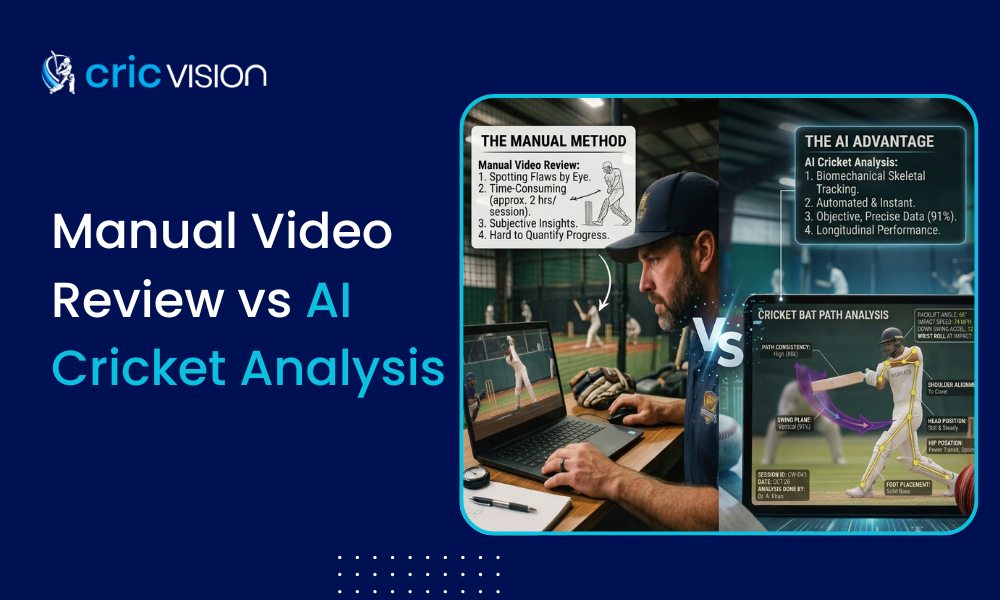
Every academy that films practice eventually hits the same wall: you have more footage than hours in the day to watch it.
A coach shoots forty net sessions on a Saturday, and by Sunday night, only a handful have been reviewed in any real detail. The rest sit in a camera roll, half-watched, waiting for a rainy day that never comes.
This is the real debate behind AI cricket video analysis vs manual review not “which is more advanced,” but “which one actually gets watched, understood, and turned into feedback a player can use this week.” Below is an honest breakdown of both approaches across time cost, consistency, and scale, plus where manual review still earns its place in a modern coaching program.
Time Cost: The Hour You Never Get Back
Manual video review is, at its core, a time-for-quality trade. A coach who wants to give one player useful, technical feedback typically needs to:
- Rewatch the session (often at normal speed, sometimes frame-by-frame for a specific fault)
- Manually clip the moments worth flagging
- Write or record notes for each clip
- Repeat this for every player in the session
For a single detailed batting review stance, backlift, bat path, footwork this routinely takes 20 to 40 minutes per player. Multiply that by a squad of 20, and one afternoon of net sessions turns into 8-plus hours of review work. Most academies don’t have that time, so what actually happens is triage: only the “problem” players or the ones asking questions get a proper look. Everyone else gets a verbal “looked fine” at best.
AI cricket video analysis vs manual review flips that math
AI-assisted tools segment footage ball-by-ball automatically, track bat path, ball path, and body position without a human scrubbing through timestamps, and generate a report in the time it takes to make a cup of tea not an afternoon. The coach’s time shifts from finding the moment worth discussing to coaching on it.
The honest caveat: AI doesn’t remove the coach from the loop. It removes the searching, clipping, and re-watching. The interpretation and the actual coaching conversation still need a human who knows the player.
Consistency and Bias: The Feedback Every Player Doesn’t Get
This is the part manual review struggles with most, and it’s rarely talked about openly.
A coach reviewing footage manually is human which means feedback quality varies by:
Time of day
The 8th video reviewed at 9pm gets a different level of attention than the 1st video reviewed fresh in the morning.
- Familiarity bias. Star players and problem players get the most scrutiny; the “middle of the pack” gets skimmed.
- Coach-to-coach variation. Two coaches at the same academy can flag completely different faults in the same clip, because manual review depends on what each coach happens to notice or prioritize that day.
- Fatigue. Reviewing footage is repetitive, detail-heavy work the exact kind of task where attention naturally drifts after the first few sessions.
None of this is a knock on coaches it’s just how manual attention works under volume. The problem is that parents and players don’t always see it that way. “Why did my son get three video notes and his teammate got none?” is a hard conversation, even when the answer is simply “there wasn’t enough time that week.”
AI-based tools apply the same measurement criteria bat speed, ball speed, backlift angle, pitch point to every player, every time, regardless of how many videos came before it or how the coach’s day is going. That consistency doesn’t replace coaching judgment, but it does mean every player gets the same baseline of objective data before a coach adds their expertise on top.
Scalability: What Happens When Your Academy Grows
Manual review scales linearly, and not in a good way double your player count, and you roughly double your review hours. For a solo coach with 15 players, that’s manageable. For an academy running multiple batches, multiple coaches, and 75-plus players (a common size once an academy starts adding a second or third program), manual review becomes the bottleneck that caps growth.
This shows up in predictable ways:
AI cricket video analysis is built to scale sideways, not just up. Processing a batch of 30 players’ footage takes roughly the same coach time as processing one the AI does the ball-by-ball segmentation and metric extraction in the background across all of them. This is the difference between an academy that can only take on new batches by hiring more coaches, and one that can grow batch sizes without proportionally growing review hours.
It’s also the difference that shows up externally: academies that can turn around a same-day report and a shareable highlight clip look and are more professional to the parents deciding where to enroll their child next season.
When Manual Review Still Makes Sense
A balanced comparison has to say where manual review wins, because it does in specific situations:
High-level, nuanced technical coaching
For an elite player working on a subtle mental or tactical adjustment (shot selection under pressure, reading a bowler’s tell), there’s no substitute for a coach’s eye and years of pattern recognition. AI gives you the metrics; the coach still makes the judgment call on intent and game awareness.
One-off, highly specific reviews
If you’re reviewing a single delivery from a match to settle a specific argument about technique, manual frame-by-frame scrubbing by an experienced coach is often faster than setting up a formal analysis workflow.
Very small squads with abundant coach time
If you coach five players and have the hours to spare, the scale problem doesn’t really apply to you yet.
Building coaching intuition
Newer coaches genuinely benefit from manually reviewing footage early in their careers; it’s how pattern recognition develops. AI tools are best layered on top of that foundation, not used as a replacement for it in coach development.
The realistic answer for most growing academies isn’t “AI or manual” it’s AI doing the repetitive measurement and clipping work at scale, freeing the coach’s manual review time for the players and moments that genuinely need a human eye.
Where CricVision Fits
CricVision was built around this exact handoff. Ball-by-ball segmentation automatically splits session footage into individual clips, so coaches stop rewatching and manually cutting video. AI markers, skeleton video, bat path, and ball path analysis surface the objective data stance, backlift, footwork, bat speed, pitch point the same way for every player, every session.
What stays in the coach’s hands is the part that should: voice and text notes on top of the AI analysis, one-tap PDF reports to send to parents, and the actual coaching conversation. Academies running CricVision typically describe the shift as going from “we’ll get to your video eventually” to same-day, consistent feedback for the whole squad without adding coaching hours.
If your academy is already sold on video analysis and the question is really about AI cricket video analysis vs manual at your current player count, the practical test is simple: multiply your squad size by the 20–40 minutes a proper manual review takes, and see if that number still fits into your coaches’ week. If it doesn’t, that’s the point where AI-assisted analysis stops being a nice-to-have and starts being the only way to keep feedback quality consistent as you grow. Book an academy demo
FAQ
Is AI cricket video analysis accurate enough to replace a coach’s eye?
No, and it isn’t meant to. AI analysis is accurate for objective, measurable data bat speed, ball speed, backlift angle, body position but interpreting why a player is making a choice, and what to prioritize in their development, is still a coaching judgment call. The best setups use AI for the measurement and the coach for the meaning.
How much time does AI cricket video analysis actually save an academy?
It varies by squad size, but the biggest saving is in the searching and clipping stage, not the coaching stage. Academies with 20-plus players typically report cutting review time from several hours per session to well under an hour, because ball-by-ball segmentation and automated metrics remove the manual scrubbing work.
Can small academies benefit from AI analysis, or is it only for larger ones?
Smaller academies benefit too, mainly through consistency and presentation every player gets the same quality of feedback and report, which matters for parent retention even at 15 players. The time-savings case simply gets stronger as player count grows.
Does switching to AI analysis mean less hands-on coaching?
It should mean the opposite. By removing the hours spent finding and clipping footage manually, coaches get more time for the actual conversation with a player which is the part AI can’t do.
What should an academy look for when comparing AI cricket analysis tools?
Look for automatic ball-by-ball segmentation (not just raw video storage), objective biomechanics tracking (bat path, backlift, footwork), the ability to add coach notes on top of the AI data, and simple report/export options parents can actually understand.