

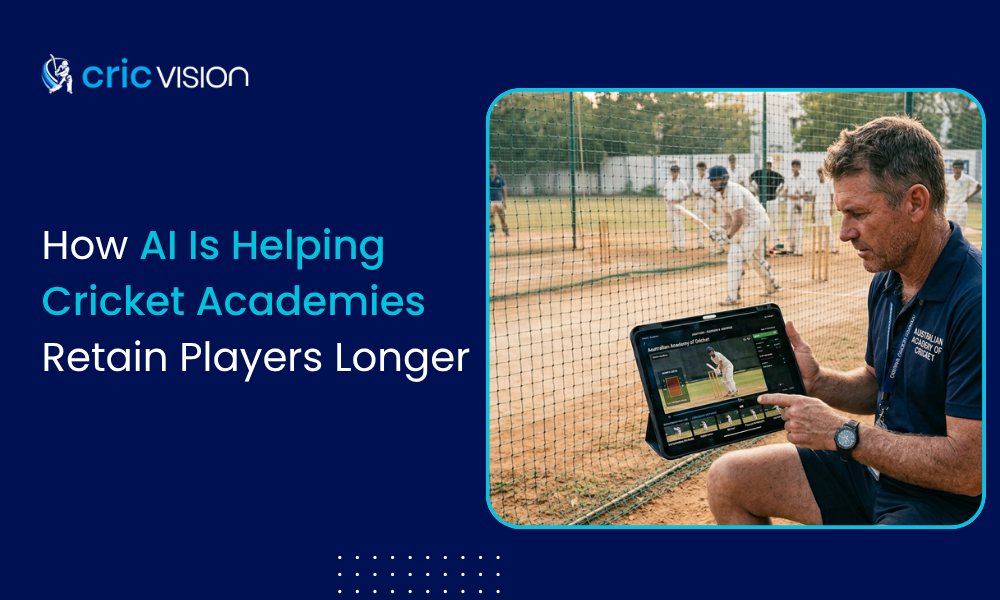
Most cricket academies don’t lose players because the coaching is bad. They lose them quietly a few at a time usually around the one-year mark right when the novelty has worn off and the player can’t yet see how far they’ve come.
By the time an owner notices the pattern in enrollment numbers it’s already cost them a season of revenue and word-of-mouth. The frustrating part is that this kind of attrition rarely announces itself. A player doesn’t storm out after a bad session they just quietly stop asking to come back and a parent quietly stops renewing. By the time it shows up as a gap in the batch the decision was made weeks earlier.
The good news is that cricket academy player retention is unusually well understood as a problem and increasingly well addressed by the same AI coaching tools academies are adopting for performance analysis. Retention it turns out isn’t primarily a coaching-quality problem. It’s a visibility problem and visibility is exactly what modern coaching technology is built to solve.
Key Takeaways
- Broader youth-sports research consistently finds that a large majority of young athletes drop out of organized sport by their early teens and “I couldn’t see myself getting better” is one of the most common reasons cited.
- In cricket academies specifically this shows up as repetitive net sessions invisible progress and parents who can’t tell if the fees are working.
- Attrition isn’t randomly distributed – it clusters around predictable points in a player’s academy journey which means it can be anticipated and addressed proactively.
- AI-powered video and progress tracking directly targets the retention problem by making improvement visible on a weekly basis not just at trials or tournaments.
- Retention gains from better visibility tend to compound a player who can see progress stays motivated and a parent who can see progress keeps paying.
- Academies using tools like CricVision report that transparency not talent identification is usually the bigger retention lever.
Why Cricket Academy Player Retention Is So Hard to Get Right
Player attrition isn’t unique to cricket. Research on youth sports participation broadly has found that a large share of young athletes stop playing organized sport by their early-to-mid teens and “it wasn’t fun anymore” or “I wasn’t improving” are consistently among the top reasons given. Cricket academies inherit this same pattern with a few sport-specific accelerants layered on top.
Net sessions become repetitive without a visible payoff
As players get older training shifts from playful skill-building to structured drilling. Without something to show for the extra structure a clear “look how much better you are now” the extra effort starts to feel like a cost rather than an investment. A ten-year-old who’s simply enjoying being on the ground doesn’t need proof of progress. A thirteen-year-old who’s been doing the same throwdowns for a year does.
Progress is invisible between now and the last time anyone checked
A coach may absolutely see a player improving a cleaner backlift better weight transfer more consistent line and length. But if that improvement isn’t communicated in a way the player and parent can actually observe, it doesn’t count for retention purposes. Perceived progress not actual progress is what keeps people enrolled. This is a subtle but important distinction: an academy can be doing excellent technical work and still lose players simply because nobody outside the coaching staff can see it happening.
Comparison to faster-progressing peers erodes confidence
Cricket development is nonlinear some players plateau for weeks before a breakthrough while a teammate seems to improve every session. Without evidence of their own trajectory players judge themselves against teammates instead and that comparison is rarely kind. A player stuck in a plateau watching someone else pull ahead doesn’t experience that as “normal variation in development.” They experience it as falling behind and falling behind is a common precursor to quitting.
Parents lose confidence before players do
Parents are usually the ones paying fees and driving to sessions often on weekends or before school. When they can’t answer “is this working?” with anything more specific than “the coach says he’s coming along” renewal becomes a harder decision every term. Parents don’t need dramatic proof they need enough specificity to feel the money and time are justified. Vague reassurance erodes that faster than most academies realize because it accumulates silently across an entire season.
Life stage competition intensifies at exactly the wrong time
As players move into their early teens school workload increases exams become more serious and other extracurricular options compete for the same after-school hours. An academy that hasn’t given a player (or their parents) a strong visible reason to prioritize cricket over an exam-prep class is fighting that competition with one hand tied behind its back.
The Retention Curve: When Academies Actually Lose Players
Attrition in youth sports academies isn’t random it tends to cluster around a few predictable points and understanding this curve makes retention efforts far more targeted than a generic “try to keep players happy” approach.
The first three months
New players are excited simply to be part of something. Attrition is typically low here regardless of how progress is communicated because novelty alone is doing the retention work.
Months four through eight
Novelty fades and the gap between effort and visible reward becomes the deciding factor. This is where academies without a structured way to show progress start losing players not dramatically, but a steady trickle.
The one-year renewal point
This is often the single highest-risk moment in the entire academy relationship. It’s the first time a parent consciously weighs a full year of cost and time against a full year of results rather than just continuing on momentum. Academies that can produce a concrete season-long trajectory at this point “here’s where they started here’s where they are now” convert renewals far more reliably than those relying on a general sense of satisfaction.
Early-to-mid teens
This overlaps with the life-stage pressures mentioned above and is consistent with the wider youth-sports research on dropout timing. It’s also frequently the point at which players start comparing themselves seriously to peers and to a mental image of what a “serious cricketer” should look like by that age.
Knowing where these risk points sit lets an academy intervene before the quiet disengagement starts rather than reacting once a spot in the batch is already empty.
The Real Cost of Player Attrition for an Academy
Attrition is often treated as an unavoidable cost of doing business some players simply move on. But the real cost compounds in ways that aren’t always obvious from the enrollment spreadsheet alone.
The referral loss line is worth dwelling on because it’s the least visible and arguably the most damaging. A parent who leaves quietly without complaint still talks to other parents at school pickup or in local parent groups. They rarely say “the coaching was bad.” They’re more likely to say something vague like “we just didn’t feel it was worth continuing” which is far more corrosive to word-of-mouth than an outright complaint because there’s nothing specific for the academy to fix and nothing to counter it with either.
The batch-economics line matters more than most owners initially assume as well. Academies typically build their pricing and coach-to-player ratios around a target batch size. When attrition quietly erodes that number over a season the per-session economics shift without anyone deciding they should the same coach facility and time cost is now spread across fewer paying players.
How AI-Powered Coaching Tools Address the Root Causes of Dropout
The retention problem above is fundamentally a visibility problem not a talent-development problem. This is exactly where AI-assisted coaching tools have made the most measurable difference for cricket academy player retention.
Making weekly progress visible instead of assumed
Video-based analysis tools can compare a player’s stance backlift or bowling action from three weeks ago against today turning an abstract sense of “coming along” into a concrete before-and-after clip. This is the same shift described in how CricVision turns player progress into a measurable outcome progress that used to live only in a coach’s memory now lives in a report a player and parent can actually look at. The value here isn’t just that the technology exists; it’s that it removes the dependency on a coach remembering reconstructing and articulating weeks of subtle change on demand.
Giving every player individual feedback even in large batches
One of the biggest structural reasons feedback stays vague is that a coach with 15–20 players simply doesn’t have time for a detailed debrief with each one every session. AI tools that auto-segment practice footage and let coaches add notes after the session rather than trying to deliver everything live close this gap without adding to a coach’s hours. This trend is covered in more depth in how AI is transforming cricket academies. In practice this means a player who might otherwise get thirty seconds of live attention per session instead gets a specific written or video-based note delivered afterward often more useful than the live correction would have been anyway since it isn’t rushed.
Turning parent conversations from reassurance into evidence
Instead of a coach telling a worried parent “he’s doing fine” a written report or a comparison clip does the reassuring on its own. Parents who can see specific trackable metrics over a season are far less likely to interpret a quiet month as a sign the academy isn’t working a shift also explored from the parent’s side in how parents can track their child’s cricket progress. This also reduces the emotional burden on coaches who otherwise end up managing parent anxiety as an unplanned unpaid part of the job.
Keeping training feel fresh through shareable moments
Short highlight clips from practice a clean cover drive a well-executed yorker give players something to be proud of and share which reintroduces some of the fun that gets lost as training becomes more structured. This matters more than it might sound: for a player in the plateau risk zone described earlier a single shareable clip of a clean shot can meaningfully shift how they feel about a training block that otherwise felt uneventful. Academies already using this approach as part of a broader growth strategy are covered in how to grow a cricket academy with technology.
Standardizing quality as an academy scales
Retention problems often get worse not better as an academy adds coaches and batches because feedback quality naturally drifts across staff. A newer coach without years of pattern-recognition experience may simply not notice the same subtle technical drift a senior coach would catch immediately through no fault of their own. Structured tool-assisted reporting gives every coach a consistent format to work from which is one reason retention and scaling tend to be discussed together see how to scale a cricket academy without losing coaching quality.
What Retention-Focused AI Adoption Looks Like in Practice
A useful way to think about this: a mid-sized academy running four to six batches a week doesn’t need to overhaul its coaching philosophy to improve retention. The change is usually structural not philosophical.
Picture a typical term. In week one every player gets a short baseline assessment nothing elaborate just a few clips and a couple of tracked metrics relevant to their stage of development. Across the following weeks coaches record a short comparison clip any time a specific technical fix visibly “sticks” not every session just the moments worth capturing. At the midpoint of the term each player and parent receives a brief report: what’s improved what’s being worked on next and a clip or two as evidence. By the end of the term that becomes a simple before-and-after story that makes the renewal conversation almost automatic because the value has already been demonstrated rather than asserted.
None of this requires more coaching hours than the academy already has. It requires:
- Every player receiving some form of progress update on a fixed cadence (monthly is common) even if it’s brief.
- At least one metric per player being tracked over time not just assessed once.
- Coaches recording a short comparison clip whenever a specific technical fix “sticks” so the improvement has visible proof.
- Parents receiving the report directly rather than having to ask for one.
None of this replaces coaching judgment it just makes the results of that judgment visible often enough that players and parents stay convinced the investment is working.
Common Objections Academies Have About Adopting AI Tools
It’s worth addressing the hesitations honestly since they’re reasonable and come up often.
Our coaches are already stretched thin this sounds like more work
The concern is legitimate but it usually rests on a misunderstanding of how these tools are meant to fit into a session not on top of it. The time cost of recording a short clip during a drill that’s already happening is minimal compared to the time a coach currently spends trying to describe a season of progress from memory during a parent conversation. Done well the tool replaces reconstructive effort with a small amount of capture effort.
Players won’t want to be filmed
In practice most players enjoy seeing themselves on video particularly when it’s framed around improvement rather than criticism. The reaction shifts substantially depending on whether video is used to highlight a positive change or solely to point out flaws academies that lead with the former tend to see enthusiasm rather than self-consciousness.
This feels like it’s for bigger better-funded academies not us
Ironically smaller academies with fewer coaches per player often have the least spare capacity for manual individualized reporting which makes the case for structural tools stronger not weaker at smaller scale.
We already give good feedback verbally why formalize it?
Verbal feedback and structured visible feedback aren’t in competition. The goal isn’t to replace the coach-player relationship with a dashboard; it’s to give that relationship something durable to point to since verbal feedback however good in the moment doesn’t survive being recalled accurately three weeks later.
A Retention Checklist for Academy Owners
Does every player receive some form of progress update at least once a month?
If updates only happen when a parent specifically asks most families will never ask and will simply draw their own often more pessimistic conclusions instead.
Can a parent see a specific skill improve over time not just hear that it has?
A verbal “coming along nicely” doesn’t survive contact with a renewal decision the way a concrete before-and-after does.
Do newer coaches have a consistent reporting format or does feedback quality vary by who’s teaching?
Inconsistency here is often invisible to the academy owner but very visible to parents comparing notes with each other.
Is there a clear visible milestone (a clip a report a small showcase) roughly every 4–6 weeks?
This maps directly onto the plateau risk zone described earlier regular milestones are what prevent that zone from turning into quiet disengagement.
When a player plateaus does the academy have a way to diagnose it or does the conversation stay vague?
A plateau that’s diagnosed feels temporary. A plateau that’s just described as “a phase” feels like evidence the academy has run out of ideas.
If most of these are unchecked that’s usually a stronger predictor of quiet dropout than the quality of the coaching itself.
FAQ
Why do players leave cricket academies even when the coaching is good?
Players and parents most often disengage because they can’t clearly see progress not because the coaching itself is weak. Without visible evidence of improvement both start to question whether continuing is worth the time and cost.
How does AI coaching software actually improve player retention?
It makes progress measurable and visible through before-and-after video comparisons tracked metrics over time and regular reports which addresses the main reason players and parents disengage: uncertainty about whether training is working.
At what age do most academies see the highest player dropout?
Broader youth sports research points to the early teenage years as the highest-risk period for dropout driven by increased competition comparison to peers and training that becomes more repetitive and less enjoyable.
Is player retention really a bigger issue for academies than acquiring new players?
Often yes. Replacing a dropped player typically costs more in marketing and trial time than retaining an existing one and a pattern of quiet attrition also affects word-of-mouth referrals which are usually an academy’s main growth channel.
Do smaller academies benefit from AI tools or is this only useful at scale?
Smaller academies often benefit the most since a single coach managing many players has the least spare time for manual individualized progress reporting, which is exactly the gap AI-assisted tools are designed to close.
What’s the single highest-leverage moment to focus retention efforts on?
The one-year renewal point tends to carry the most weight since it’s the first time a parent consciously evaluates a full year of cost and time against a full year of results. Having a clear evidence-based season summary ready for that moment matters more than any single session in between.
Will adding video and reporting tools make coaching feel less personal?
Not if it’s used to support the coach-player relationship rather than replace it. The goal is to give verbal coaching something durable to point back to a clip a report a tracked trend not to substitute technology for the relationship itself.
Final Thought
Retention in youth cricket coaching comes down to one question a player and their parent are quietly asking every term: “is this still working?” That question doesn’t usually get asked out loud it gets answered silently in the decision to renew or quietly walk away. Academies that can answer it with evidence not just reassurance keep players longer because they’ve removed the guesswork from a decision that used to rest entirely on trust and memory.
Tools like CricVision are built to make that evidence easy to produce session after session without adding to a coach’s workload. Strong cricket academy player retention doesn’t require replacing what good coaches already do it just requires making sure the results of that coaching don’t stay invisible long enough to cost the academy a player.