
 Author: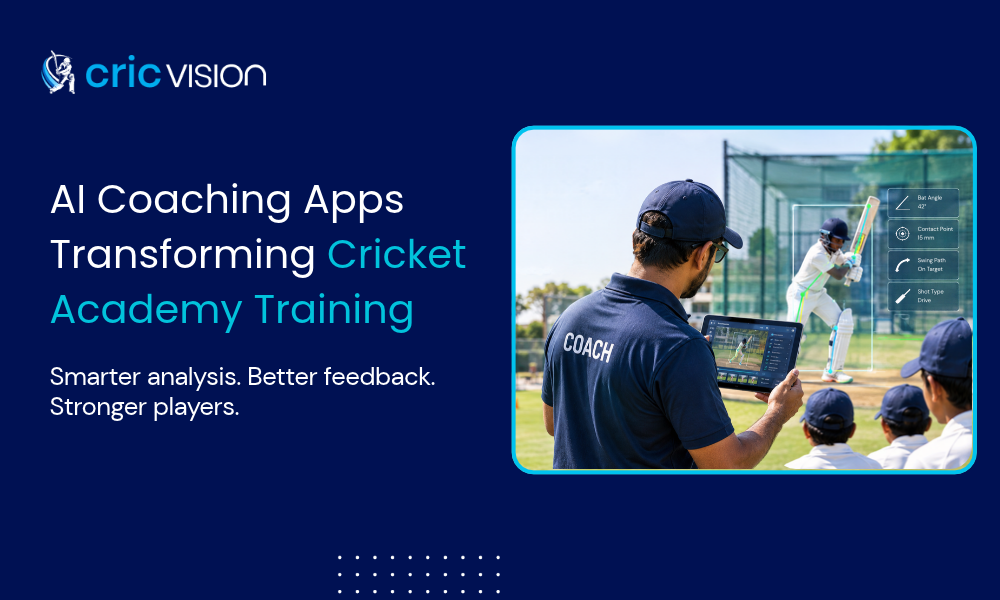
It is the end of a busy training session. A head coach has just finished working with three groups of players, and there are still dozens of videos sitting on a phone. One batter needs help with balance, another keeps repeating the same movement at impact, and a junior player has made progress but needs evidence of it before the next parent review.
The coach knows the footage could answer these questions, but reviewing every delivery, cutting clips, writing notes, and following up with each player could take hours. For a growing cricket academy, this is the difficult gap between having performance data and actually having enough time to use it.
That challenge is becoming more important as participation grows. The England and Wales Cricket Board reported that its recreational cricket network had more than 1.2 million participants across 5,700 clubs and more than 43,000 teams in 2026. The ICC has also reported significant growth in cricket participation outside its Full Member nations.
More players create more opportunities for coaches, but they also create a practical coaching problem: how do you maintain individualized, evidence-based feedback when the number of players increases?
This is where AI coaching apps are beginning to change cricket academy training.
The most useful role for AI is not replacing the coach. It is reducing the repetitive work around coaching reviewing footage, finding important moments, organizing performance information, comparing sessions, and communicating progress so coaches can spend more time making decisions and developing players.
Why Traditional Cricket Coaching Becomes Harder as an Academy Grows
Experienced coaches already know how to identify technical problems. The challenge is doing it consistently across a large group of players.
During a live session, a coach may be watching one batter while also preparing the next drill, monitoring another player, answering a question, and keeping the session moving. A small technical error can happen in a fraction of a second.
A slight change in head position, balance, footwork, bat path, or timing may not be obvious while watching the action live.
Video helps because the coach can revisit the exact movement. However, traditional video review introduces another problem: time.
A coach who records a 90-minute session may have to search through the footage manually to find specific deliveries or shots. Then the coach needs to select useful clips, add explanations, compare them with previous sessions, and communicate the findings.
Research into elite sports coaching supports this problem. A study of Olympic and Paralympic coaches found that time availability had the greatest impact on feedback provision, while video, performance reports, and trend analysis were among the analysis techniques used by coaches.
The issue, therefore, is not whether coaches understand the value of analysis.
It is whether the analysis process can fit realistically into a coach’s workload.
What AI Video Analysis Adds to Cricket Coaching
AI video analysis combines video processing, computer vision, and performance data to make recorded training sessions easier to review.
Instead of treating a training video as one long recording, an AI-assisted system can help identify individual actions, organize clips, detect movement patterns, and connect footage with performance information.
For cricket academies, this can make a difference in several areas.
1. Coaches Can Spend Less Time Searching Through Video
Consider a coach reviewing a batting session with 20 players.
Without an efficient review system, the coach may need to move through the recording manually, identify the relevant shots, pause the footage, rewind, and repeat the process.
AI-assisted video analysis can automate parts of that workflow by segmenting training footage and making important moments easier to locate.
Instead of spending most of the review process finding clips, the coach can spend more time asking:
- What technical issue matters most?
- Is the player repeating the same mistake?
- Has the previous correction worked?
- What should the player practice next?
That distinction is important. Automation should remove repetitive review work, not remove coaching judgment.
Coaches looking to understand the broader role of technology can also explore how AI-powered cricket coaching and technology is changing the way training sessions are analyzed and managed.
2. Technical Feedback Becomes More Visual and Specific
A coach might tell a batter:
“Your head is moving too far during the shot.”
That instruction may be correct, but the player still has to understand exactly when and how the movement occurred.
With video, the coach can show the player the specific frame.
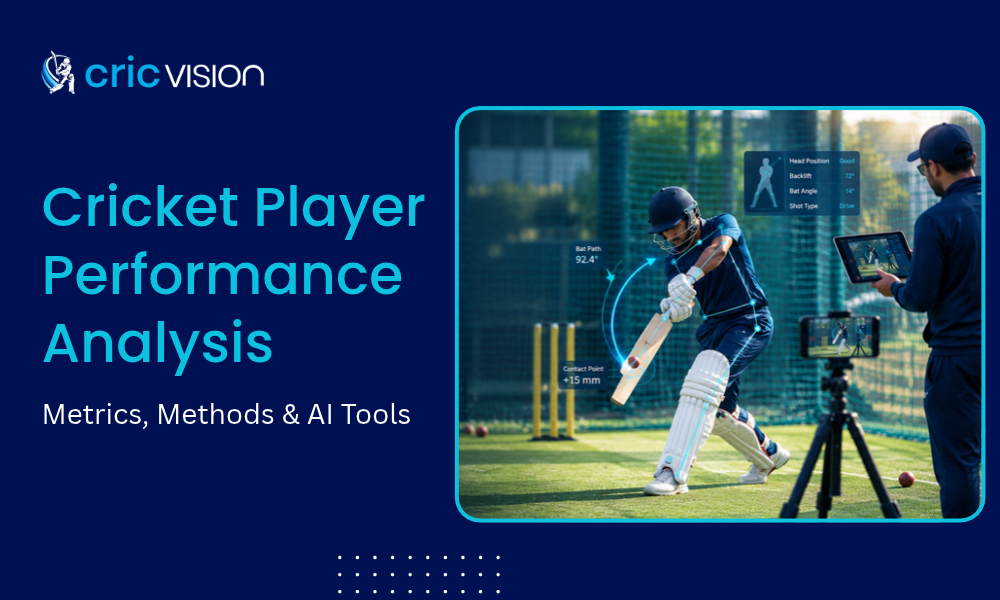
AI can make this process more detailed by helping analyze elements such as:
- Bat path
- Head position
- Stance
- Footwork
- Balance
- Backlift
- Impact position
- Ball path
- Body movement
The coach can then interpret those observations within the context of the player’s skill level and training objective.
This is particularly valuable for junior players. Instead of giving a general correction, a coach can show the player exactly what happened and connect the observation to a drill.
Research on AI-enhanced video feedback in coaching found that coaches reported deeper reflection, greater self-awareness, and more specific changes to their practice after working with video and AI-generated data.
However, technology cannot fully understand the subtle context and nuances of a coaching conversation.
That is why AI works best as evidence for the coach, rather than as the coach.
Coaches can also learn more about the technical mistakes video analysis can uncover that may be difficult to identify during a live training session.
3. Player Progress Becomes Easier to Track
One of the biggest weaknesses of purely verbal coaching is that progress can become difficult to document.
A player may hear the same correction several times:
“Keep your head still.”
“Improve your balance.”
“Work on your timing.”
But after several weeks, how does the coach determine whether the player has actually improved?
A single session rarely provides the answer.
Progress becomes much clearer when coaches can compare footage and performance information across multiple sessions.
For example, a coach might compare:
Session 1 → Session 4 → Session 8
and look for changes in:
- Technical consistency
- Movement patterns
- Shot execution
- Timing
- Balance
- Decision-making
- Specific coaching objectives
The goal is not to turn every player into a collection of numbers. The goal is to create a development history.
This becomes particularly useful in academies where several coaches work with the same players. A structured digital record helps the coaching team understand what has already been addressed and what the player should work on next.
It also makes progress easier to explain to parents.
4. Feedback Can Become More Consistent Across Multiple Players
Consistency is one of the biggest challenges for a growing academy.
A coach might give excellent feedback to the player receiving individual attention but have less time to provide the same level of detail to everyone else.
That does not necessarily mean the coach is doing a poor job. It is often simply a capacity problem.
AI-assisted coaching tools can help standardize parts of the review process.
For example, every player can have:
- Training footage
- Key clips
- Coach observations
- Performance indicators
- Development priorities
- Historical comparisons
- Progress reports
The coach still decides what is important.
But the underlying information becomes easier to organize.
This matters because player development is rarely about one excellent coaching session. It is about delivering useful feedback repeatedly over time.
5. Coaches Can Turn Data Into Better Training Decisions
Performance data is useful only when it changes what happens during training.
A dashboard filled with statistics does not automatically improve a player.
The real value comes when data answers practical coaching questions:
What is the player’s biggest technical priority right now?
Has the previous correction worked?
Which skill needs another training block?
Is the player becoming more consistent?
What should the next session focus on?
This is where AI-assisted analysis can connect observation with training planning.
Instead of reviewing a player’s performance and simply recording what happened, the coach can use the information to determine what happens next.
That creates a more continuous cycle:
Capture → Analyze → Coach → Practice → Compare → Adjust
The technology supports the cycle, but the coach remains at the center of it.
6. Communication Between Coaches, Players, and Parents Becomes Clearer
Player development does not happen only during the training session.
Players need to understand what they should work on. Parents particularly parents of junior players often want to understand whether their child is improving and what the coaching team is focusing on.
This can be difficult when communication depends mainly on occasional conversations.
Research involving 6,641 parents of young athletes found that 29.4% reported feeling a lack of communication with their child’s coach.
The finding is not specific to cricket, but it highlights a broader challenge in youth sports: communication is an important part of the athlete-development relationship.
Digital coaching tools can help by connecting communication to actual training evidence.
Instead of sending a generic message such as “Your child is improving,” a coach can provide a more meaningful update:
What improved: Balance during front-foot shots
What needs attention: Head movement at impact
Next focus: Repeat the movement through a specific drill
Evidence: Recent training clip compared with an earlier session
That is a much stronger coaching conversation.
It gives the player something concrete to work on and gives the parent a clearer understanding of the development process.
7. AI Helps Coaches Scale Attention Without Diluting Coaching Quality
This may be the biggest opportunity for cricket academies.
Growth usually means more players, more training groups, and more footage.
But coaching quality should not decline simply because the academy becomes larger.
For academy owners and high-performance coaches, the lesson is straightforward: as the player base grows, coaching workflows need to become more efficient.
AI can help by taking over portions of the information-processing workload.
That could mean automatically organizing footage, creating clips, identifying useful moments, generating structured reports, or maintaining a searchable player history.
The objective is not to give a coach less involvement.
It is to make the coach’s involvement more valuable.
What This Looks Like in a Real Cricket Academy
Imagine a junior batter who has been struggling with consistency.
During three consecutive sessions, the coach notices that the player occasionally loses balance while playing certain shots.
Previously, the coach might remember the issue and mention it during the next session.
With an AI-assisted video workflow, the coach can review the relevant clips, compare the player’s movement across sessions, annotate the key moment, and create a focused coaching note.
The player can then see the issue rather than simply hearing about it.
At the next session, the coach can check whether the adjustment has transferred into practice.
A few sessions later, the coach can compare the new footage against the earlier clips.
The process becomes evidence-based:
Problem → Visual evidence → Coaching correction → Practice → Reassessment
That is a much more useful application of AI than simply producing another performance score.
Where CricVision Fits Into This Coaching Workflow
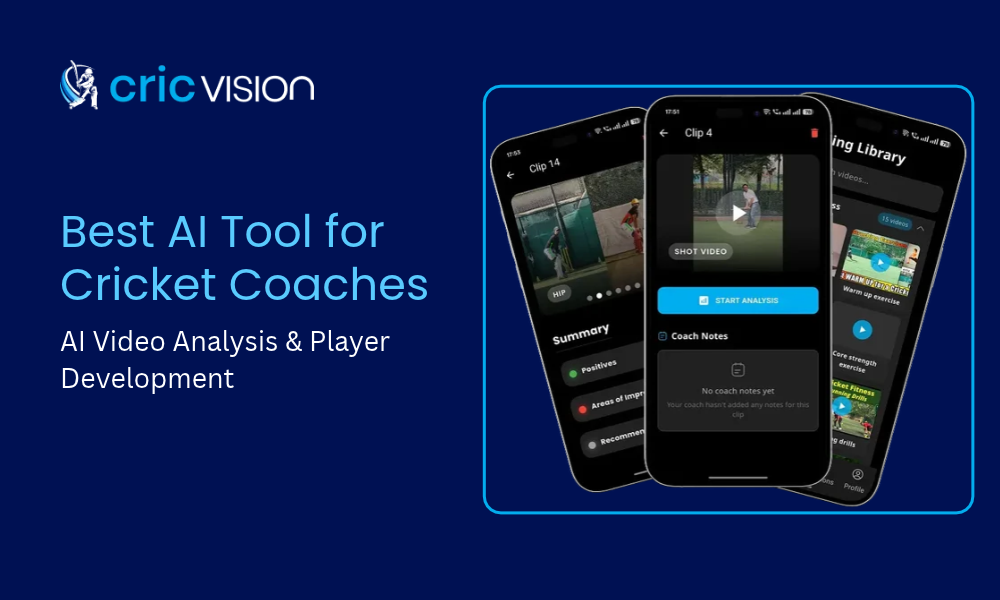
For cricket academies dealing with manual video review, inconsistent feedback, limited visibility into player progress, and fragmented communication between coaches, players, and parents, CricVision brings these parts of the workflow together through AI-powered video analysis and digital coaching tools.
The practical value is straightforward.
A coach can spend less time searching through long recordings and more time reviewing the moments that require judgment. Players can receive feedback connected to actual video evidence. Progress can be documented across sessions rather than relying entirely on memory. Parents can receive clearer visibility into what their child is working on and how development is progressing.
The important point is that the technology supports the coaching relationship rather than replacing it.
AI Should Support the Coach, Not Replace the Coach
There is a temptation to describe AI as if it can independently understand every aspect of a cricketer’s performance.
That is unrealistic.
A technical metric does not tell the whole story.
A coach understands factors that a video system may not see clearly: confidence, fatigue, match pressure, learning style, motivation, previous injuries, tactical intent, and how a particular player responds to different forms of feedback.
AI can identify patterns and organize evidence.
The coach decides what those patterns mean.
This distinction becomes even more important with junior players, where development should not be reduced to rankings or scores.
The best approach is therefore coach-led and AI-assisted.
AI handles more of the repetitive work. You may also find our post on Ai transforming cricket academies useful here. Coaches retain responsibility for interpretation, training design, communication, and player development.
How Cricket Academies Can Start Using AI Effectively
An academy does not need to automate its entire coaching process.
A better starting point is to identify the areas where coaches repeatedly lose time.
For many academies, that could be:
1. Video review
Start recording selected training sessions and use technology to reduce the time required to find useful clips.
2. Player progress
Define a small number of meaningful technical or performance objectives for each player and track them over time.
3. Feedback
Connect coaching comments to specific video evidence instead of relying only on verbal instructions.
4. Communication
Create a consistent process for sharing relevant progress updates with players and parents.
5. Review cycles
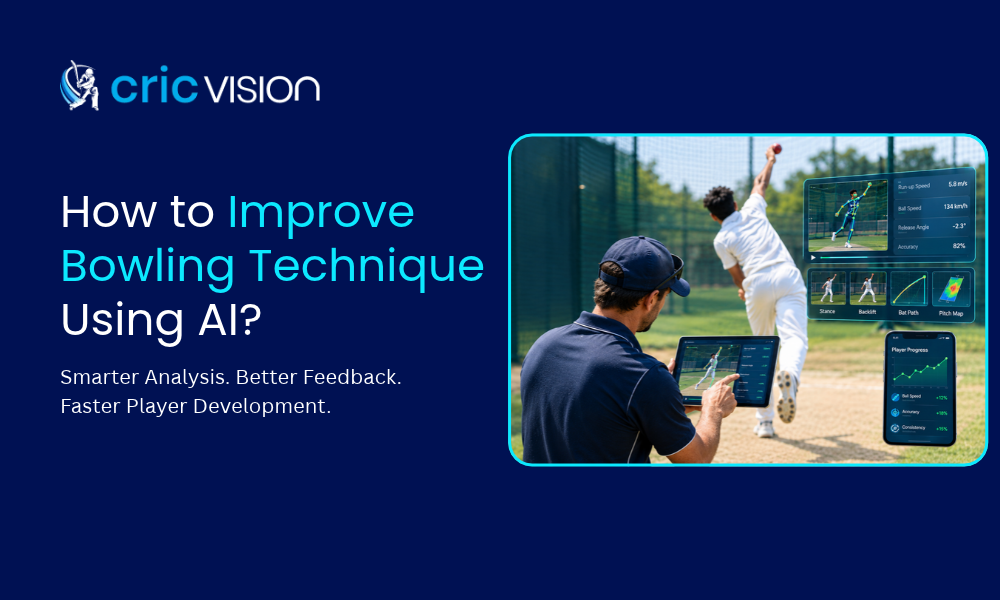
Compare current performance with previous sessions rather than evaluating every session in isolation. For a deeper look, read our guide on bowling technique using AI.
The objective should always be better coaching not more technology.
Frequently Asked Questions About AI Coaching Apps for Cricket Academies
What is an AI coaching app for cricket?
An AI coaching app uses technologies such as computer vision, video analysis, and performance data to help coaches review cricket training more efficiently. We cover this in more detail in our article on AI improves cricket coaching. Depending on the platform, it can help identify important moments in a session, analyze player movements, organize video clips, track progress, and support feedback.
The coach remains responsible for interpreting the information and deciding how it should influence training.
How can AI video analysis help cricket coaches save time?
AI can reduce the amount of manual work involved in reviewing training footage. Instead of searching through long recordings to find individual shots or deliveries, coaches can use automated segmentation and analysis to locate relevant moments more quickly.
The time saved can then be redirected toward coaching decisions, player discussions, and session planning.
Can AI analyze a cricket player’s batting technique?
Yes. AI-powered video analysis can assist with analyzing aspects of batting technique such as stance, balance, head position, bat path, footwork, impact position, and movement patterns.
However, these measurements should be treated as supporting evidence. A qualified coach still needs to interpret the player’s technique within the context of their skill level, training objectives, and match situation.
How can cricket academies track player progress with AI?
AI-assisted coaching platforms can store video, performance observations, reports, and other information over multiple sessions. Coaches can then compare earlier and more recent performances to identify changes in technique and consistency.
This creates a longer-term development record instead of evaluating a player based only on the most recent training session.
Can AI coaching apps replace cricket coaches?
No. AI is better viewed as a coaching support tool rather than a replacement for a cricket coach.
AI can process video and performance information quickly, but coaches provide the context, experience, tactical understanding, communication, motivation, and individualized instruction that technology cannot fully replicate.
How can AI improve communication between cricket coaches, players, and parents?
AI-assisted coaching platforms can make feedback more structured by connecting coaching observations with video clips and player progress information. Coaches can use this evidence to explain what a player has improved, what still needs attention, and what the next development goal should be.
For parents of junior players, this can provide a clearer picture of development than occasional verbal updates alone.
Is AI useful for junior cricket players?
Yes, when it is used appropriately. Junior players can benefit from visual feedback because seeing a specific movement or technical issue can make a coaching instruction easier to understand.
The coach should still control how feedback is delivered and ensure that technology supports development rather than placing excessive emphasis on scores or rankings.
What should a cricket academy look for in an AI coaching app?
Academies should look beyond the word “AI” and evaluate whether the platform actually solves coaching problems. Important considerations include video-analysis capabilities, ease of reviewing clips, player-progress tracking, coach feedback tools, communication features, data organization, and how easily the system fits into existing training workflows.
The best platform is the one that reduces unnecessary work while giving coaches better evidence for player-development decisions.
The Future of Cricket Academy Coaching Is More Measurable, Not Less Human
AI coaching apps are changing cricket academy training because they address a very practical problem: coaches have limited time, while players need increasingly individualized attention.
Video analysis can make technical problems easier to see. Performance data can make progress easier to measure. Digital reports can make feedback more consistent. Communication tools can help players and parents understand the development process.
Research increasingly supports the value of purposeful video feedback, while also making clear that technology works best when it is integrated into a thoughtful coaching process.
For academy owners, head coaches, high-performance coaches, and junior coaches, that is the real opportunity.
AI does not need to make coaching less personal.
It can give coaches more time to observe, explain, challenge, encourage, and develop players while reducing the repetitive work that happens around those activities. If AI can give coaches better evidence, more time, and a clearer view of every player’s development, why not make it part of the coaching process?
Ready to grow your academy?
Book a CricVision demo and see it working with your own sessions.